
Alexander McQueen was never just a fashion designer; he was a storyteller, a rebel, and a master tailor who turned the runway into pure theatre. From razor-sharp suits born out of Savile Row training to hauntingly beautiful shows that blurred the line between art and fashion, McQueen made London the beating heart of his genius—and the fashion industry still hasn’t stopped talking about him.
Why Alexander McQueen Still Haunts the Runway
If the fashion world ever had a real-life Cruella (minus the Dalmatians, plus better tailoring), it would be Alexander McQueen. Dark, daring, and just a little bit dangerous, McQueen wasn’t your average designer. He wasn’t simply making clothes—he was staging theatre, telling stories, and sometimes dragging the audience through nightmares stitched in silk and tartan.
He lived fast, created fiercely, and left us far too early in 2010. Yet, more than a decade later, his influence still lingers like a ghost at London Fashion Week—haunting, inspiring, and impossible to ignore.
From London’s East End to Savile Row: The Tailor Who Became a Legend
Born Lee Alexander McQueen in 1969, he grew up in London’s gritty East End. Dad was a cab driver, mum a teacher, and little Lee? Well, he was already making dresses for his sisters out of whatever fabric he could find. (Iconic, right?).
At 16, he dropped out of school and landed on Savile Row, the holy land of tailoring. He worked at Anderson & Sheppard and later Gieves & Hawkes, learning precision so sharp it could cut glass. Rumour has it, he even stitched cheeky insults into the lining of suits for high-profile clients like Prince Charles. That mischievous tailoring streak? Pure McQueen.
This Savile Row background gave him what most designers dream of—flawless technical mastery. Unlike many “conceptual” designers, McQueen could cut a jacket that fit like armour, then destroy it theatrically on the runway.
Isabella Blow and the Birth of “Alexander McQueen”
The fairy godmother of this story? Fashion legend Isabella Blow. When McQueen presented his Central Saint Martins MA graduation collection in 1992—ominously titled Jack the Ripper Stalks His Victims—Isabella didn’t just clap politely. She bought the entire collection for £5,000 and declared him the future of fashion.
She also insisted he drop “Lee” and go by Alexander McQueen—and just like that, a brand was born. (If you’ve ever dreamed of someone discovering you and transforming your life overnight, this was it.)
Shock, Awe, and Bumsters: Early Collections that Shook the Industry
McQueen didn’t just design; he provoked. Take his Taxi Driver collection (1993), inspired by both the film and his father’s cabbie days. It introduced the now-infamous “bumster” trousers—so low they made waistbands obsolete. Fashion critics clutched their pearls; club kids cheered.
Then came Highland Rape (1995). Torn tartans, distressed fabrics, models stumbling as though attacked—it scandalised the press. Yet McQueen insisted it wasn’t about violence against women but a commentary on England’s brutal history with Scotland. Controversy or genius? Probably both.
And The Birds (1995), inspired by Hitchcock’s horror classic, showed his knack for making audiences uncomfortable in the best way possible. Suddenly, fashion wasn’t just clothes—it was storytelling, protest, theatre.
McQueen vs. Givenchy: A London Rebel in a Parisian House
By 1996, McQueen’s infamy had skyrocketed so much that Givenchy came calling. At just 27, he became the creative director of the Parisian couture house, succeeding John Galliano. Imagine: a working-class boy from London’s East End suddenly running one of the most elite French brands.
But Parisian refinement and McQueen’s raw rebellion were like oil and water. His time at Givenchy was marked by tension (and some very spicy interviews where he didn’t hold back). Still, the stint gave him visibility, resources, and a global platform. By 2000, Gucci (now part of Kering) acquired a majority stake in its label, allowing it to expand without compromising creative control.
Runway as Theatre: Robots, Holograms, and Atlantis Queens
If Thierry Mugler gave us space-age couture, McQueen gave us gothic theatre. His shows weren’t runway presentations—they were events people whispered about for years.
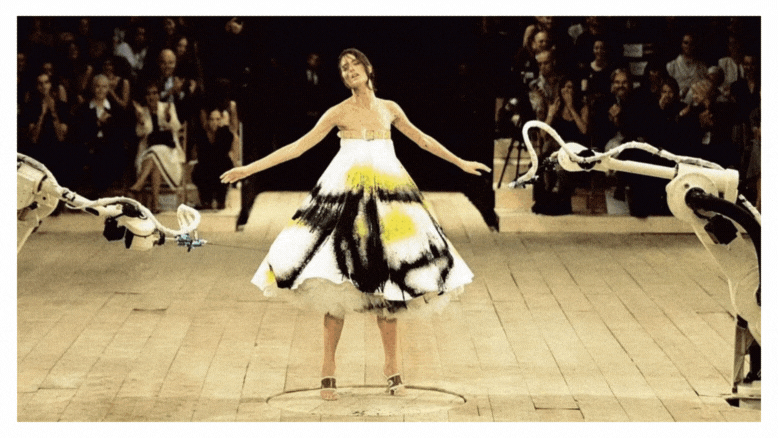
- No. 13 (Spring/Summer 1999): Model Shalom Harlow stood in a white dress while two robotic arms spray-painted her live on stage. Fashion as performance art, literally.
- The Widows of Culloden (Autumn/Winter 2006): A hologram of Kate Moss floated in a swirling gown—a ghostly vision that left audiences in tears.
- Plato’s Atlantis (Spring/Summer 2010): A futuristic ocean-inspired collection with reptilian “armadillo” heels (later worn by Lady Gaga). It was also the first fashion show streamed live online—proving McQueen wasn’t just about theatrics, but innovation.
Each show was part horror film, part Shakespearean drama, part couture fantasy. Honestly, Cruella would’ve taken notes.
Craftsmanship & Collaborations: Not Just Clothes, But Sculptures
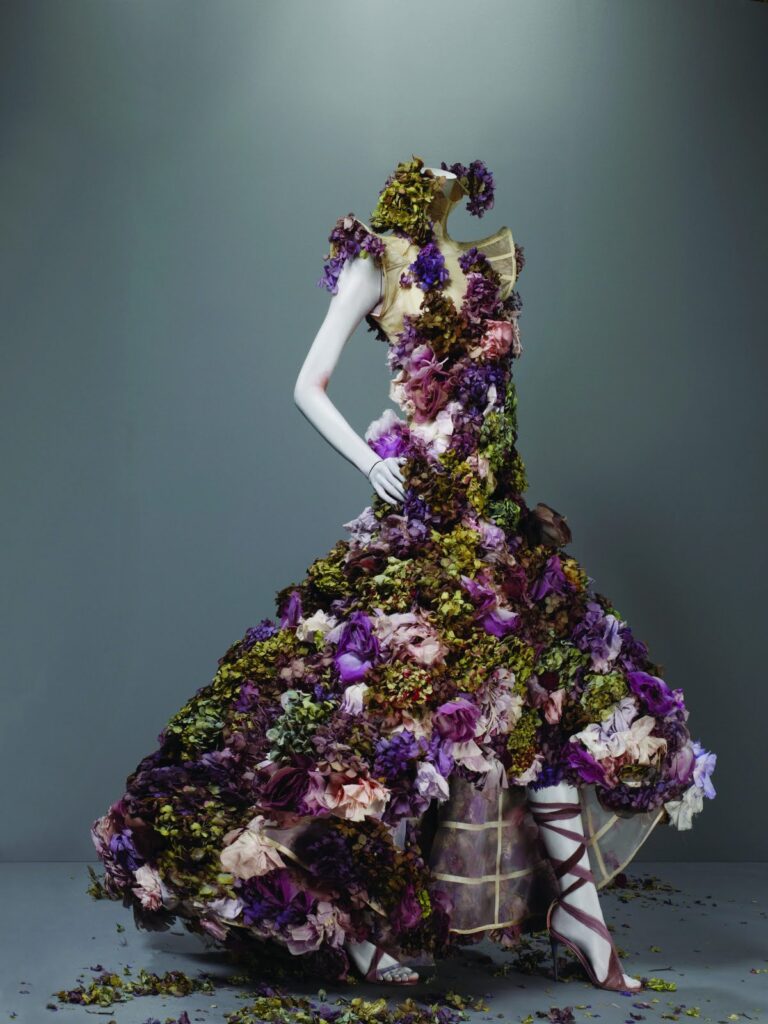
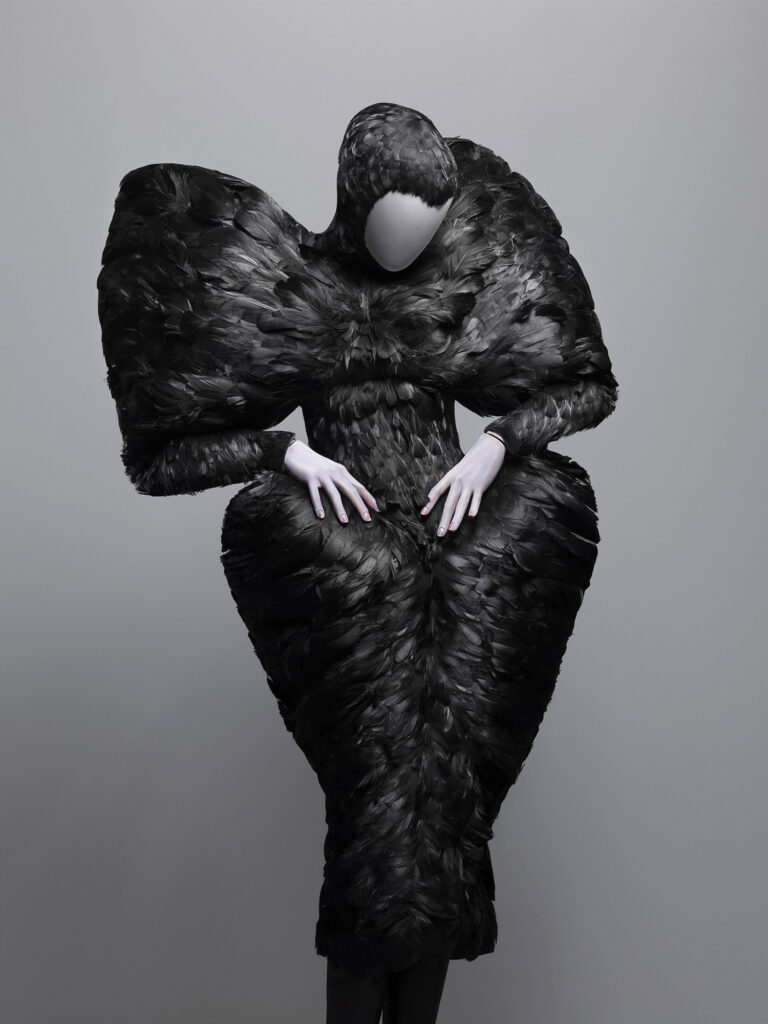
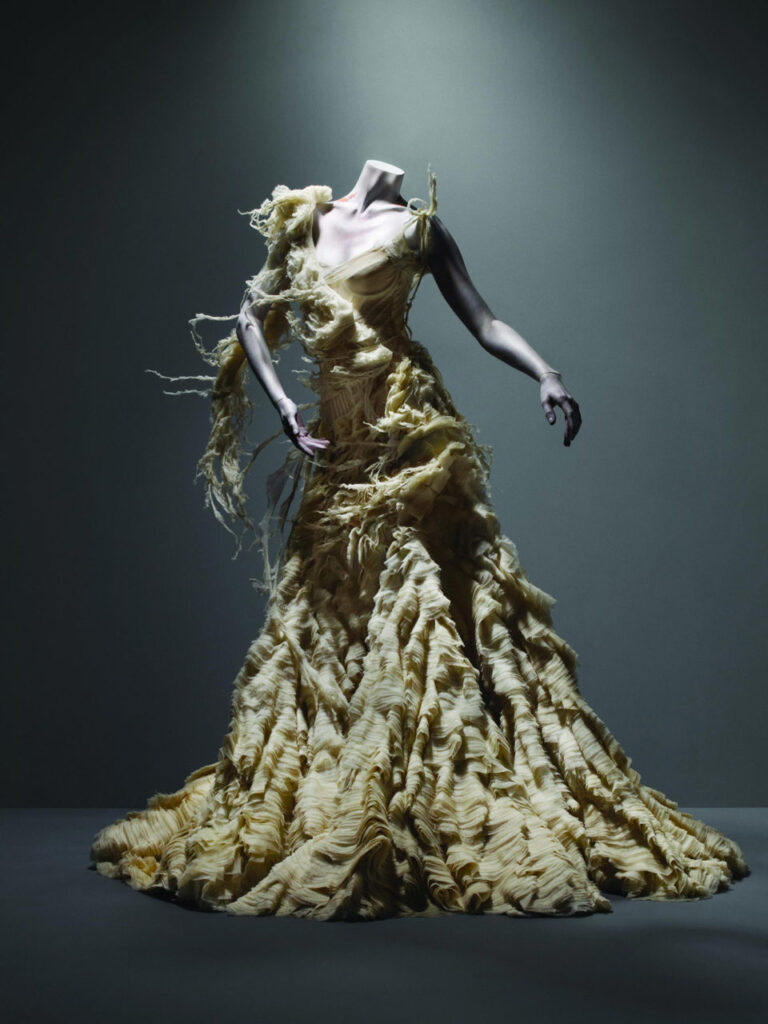
Here’s the thing: McQueen wasn’t all shock value. Beneath the drama was exquisite craftsmanship. His Savile Row training showed in the razor-sharp tailoring. But then he layered it with fantasy.
He collaborated with jewellers like Shaun Leane, who created his spine-like jewellery and metal corsets. Milliner Philip Treacy added surreal headpieces. McQueen worked with embroiderers, leather workers, and even feather artisans. Clothes became sculptures, stories, and living art.
This wasn’t ready-to-wear you grabbed off a rack—it was couture that blurred lines between fashion, theatre, and museum-worthy art.
Creativity, Darkness, and Mental Illness
Behind the genius was a man wrestling with demons. McQueen often said his work was a release for his inner struggles. His shows carried themes of death, violence, beauty, and rebirth—mirroring his battles.
His mentor, Isabella Blow’s suicide in 2007, devastated him. The pressure of running a global brand, alongside personal struggles with identity and mental health, weighed heavily. McQueen’s brilliance was inseparable from his fragility—a reminder of how creativity and mental illness often dance on the same knife’s edge.
It’s why his collections hit so hard: they weren’t just fabric. They were raw emotion, stitched into every seam.
The Final Curtain: Legacy After 2010
On February 11, 2010, just days before London Fashion Week and shortly after his mother’s death, Alexander McQueen took his own life at 40. The fashion world was stunned.
His final collection, completed posthumously by his team, felt like a goodbye letter—regal, spiritual, and haunting. Later that year, the “Savage Beauty” exhibition at the Metropolitan Museum of Art became one of the most visited fashion exhibitions in history. McQueen’s place in culture was sealed—not just as a designer, but as an artist.
Sarah Burton, who had worked closely with him, took over as creative director. She designed Catherine Middleton’s wedding dress in 2011, proving McQueen’s label could balance dark fantasy with regal elegance. Fast forward, and in 2023, Seán McGirr took the reins, tasked with carrying McQueen’s DNA into the future.
Why Alexander McQueen Will Always Be Irreplaceable
So why do we still talk about him? Because nobody told stories like Alexander McQueen. Because no one else made tailoring look like armour, or made runway shows feel like gothic operas.
He turned fashion into a stage play where beauty and horror collided. McQueen showed us that clothes could provoke, unsettle, or even heal. He gave London another rebel to boast about, inspired countless in the creative industry, and proved that artistry in fashion can stand shoulder-to-shoulder with painting, film, or theatre.
For me (and for many), Alexander McQueen will always be more than a brand. He was the dark prince of fashion—the genius who stitched poetry out of pain and left us with a legacy no one can quite replicate.