
Balance has always been less about symmetry in my work and more about tension — the quiet, often uncomfortable coexistence of opposites. My abstract black and white paintings circle themes of inner conflict, shadow selves, and emotional extremes, treating them not as problems solve but as states to observe. Working without colour strips the canvas of distraction and forces an engagement with form, contrast, and psychological weight. In earlier explorations, including works like Mind, Trust is a Deception, Soul of a Firestorm, and my studies rooted in chiaroscuro, I have been drawn to how light does not eliminate darkness but depends on it to exist.
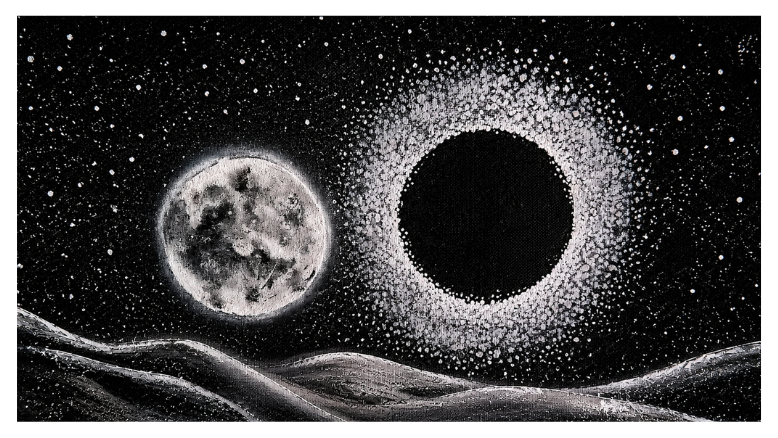
This inclination is deeply shaped by the art movements that continue to influence me. The dreamlike distortions of Salvador Dali’s Surrealism, the fractured perspectives of Cubism, the emotional urgency of Early Expressionism, and the restraint of Abstraction all inform how I approach a blank surface. Even traces of Impressionism linger, not in colour, but in the idea of capturing a momentary state rather than a fixed truth. These two black-and-white paintings, centred on the sun and the moon, emerge from that continuum. Less as representations of celestial bodies and more as reflections on presence, absence, and the unseen forces that govern both the universe and the self.
Balance as a Celestial Dialogue
Balance, as I have come to understand it, is not the absence of conflict but the quiet acceptance of duality. Across cultures and philosophies, this idea appears in various forms — yin and yang, light and shadow, masculine and feminine, movement and stillness, yet always points to the same truth: nothing exists in isolation. The cosmos structures itself through cycles of creation and dissolution, expansion and retreat. Vedic thought understands this not as a contradiction. But as rhythm, the continual breathing of the universe, where opposing forces sustain rather than cancel each other.
In black and white abstraction, this dialogue becomes unavoidable. Without colour to soften contrast, light and darkness must negotiate space directly. Much like chiaroscuro, light here does not overpower shadow; it emerges because shadow allows it to be seen. The black canvas becomes silence, depth, and potential, while white acts as interruption, awareness, and presence. This is where balance reveals itself, not as easy harmony, but as a lived equilibrium. Shaped by tension, dependence, and the continual exchange between what is visible and what remains unseen.
Canva I: The Sun – Expansion without Occupation
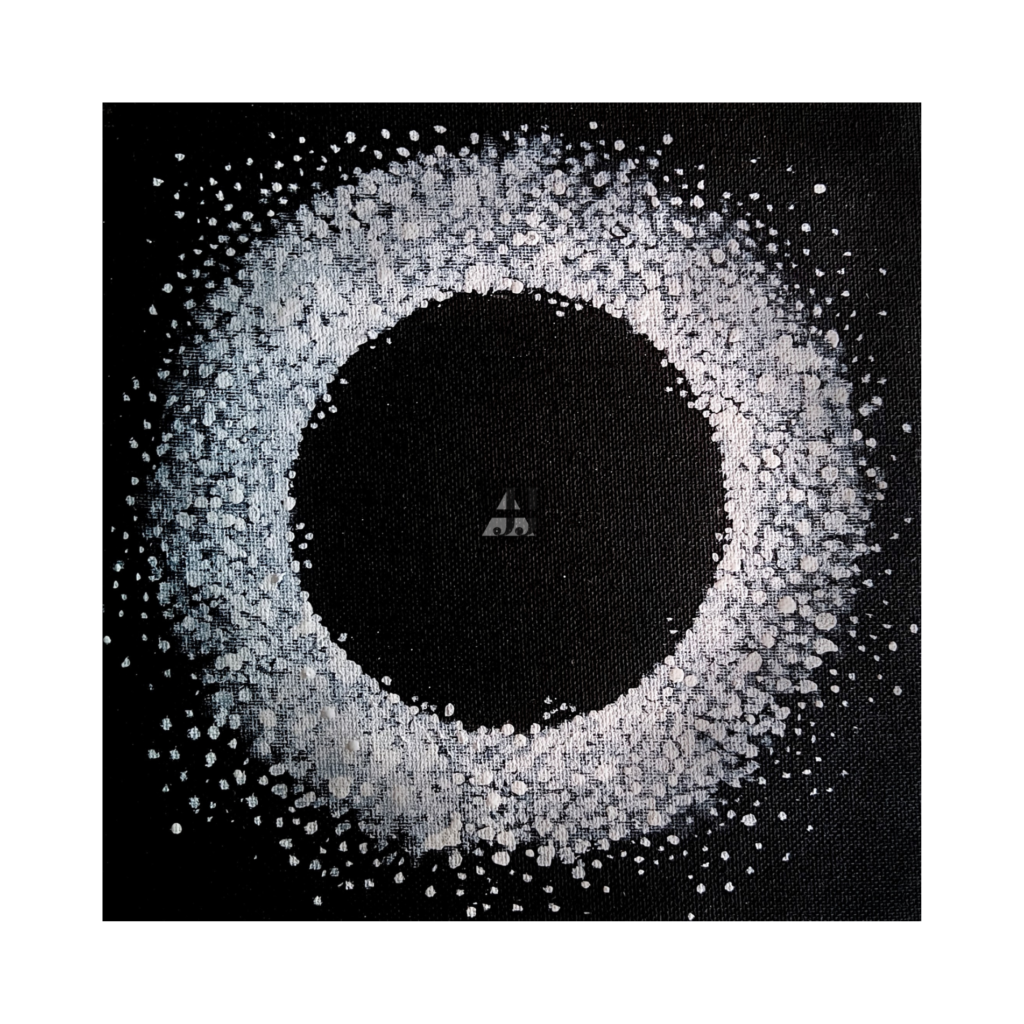
In this painting, the sun resists its most familiar portrayal. Instead of occupying the centre with colour or form, it appears as an absence — a dark core surrounded by scattered white rays. The brightness exists at the edges, implied rather than declared. This inversion challenges our reading of power and presence, revealing that expansion does not always require occupation and visibility does not always need a centre.
Across cultures, the sun has symbolised vitality, authority, and outward force; from the solar deities of ancient civilisations to the masculine principle of action and creation. Yet many philosophies, including Vedic thought, understand true potency as something contained rather than displayed. Here, light behaves less like domination and more like influence. The surrounding rays hint at energy in motion, while the dark centre holds restraint. The sun becomes a quiet force, one that radiates without consuming the space it inhabits.
Canva II: The Moon – Imperfection and Reflection
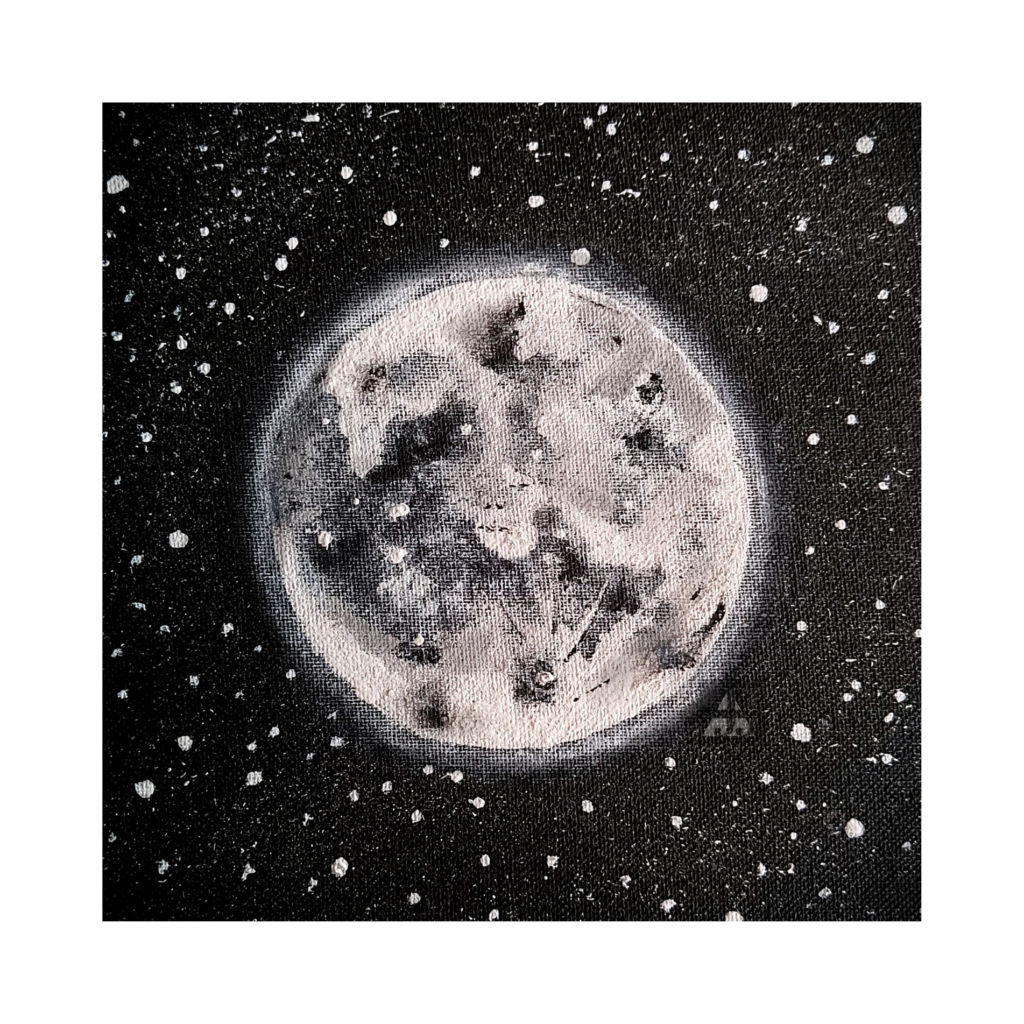
The moon, often idealised as flawless in poetry and longing, appears here marked and uneven. Its surface carries textures and spots, resisting romantic perfection. Rather than standing as an object of beauty alone, it becomes a site of reflection, shaped by time, shadow, and proximity to darkness. The stars surrounding it remain subtle, allowing the moon’s quiet gravity to define the space.
Across cultures, the moon has long been associated with intuition, emotion, and the cyclical nature of life. In Vedic philosophy, it governs the mind — fluid, receptive, and ever-shifting. Its light is not its own, yet its influence is profound. In this painting, reflection becomes power, and restraint becomes presence. The moon’s imperfections do not diminish it. They reveal its truth, that softness and depth often emerge from what is incomplete.
Balance in Light and Shadow
Together, the sun and the moon form not a contrast of opposites, but a shared system of dependence. Their relationship mirrors a larger truth echoed across philosophies — that existence is sustained through duality, not resolution. Light needs shadow to define it; action needs stillness to hold meaning; expansion must be met with restraint. This interplay extends beyond the celestial into emotional and human experience, where strength and vulnerability continually shape one another.
Balance, in this sense, is not something to be achieved once and held permanently. It is a state of awareness, a willingness to recognise cycles, tensions, and transitions as essential rather than disruptive. In black and white, stripped of excess, this understanding becomes more visible.
What remains is not certainty, but continuity, a reminder that light and shadow are not enemies, but participants in the same, enduring rhythm.