
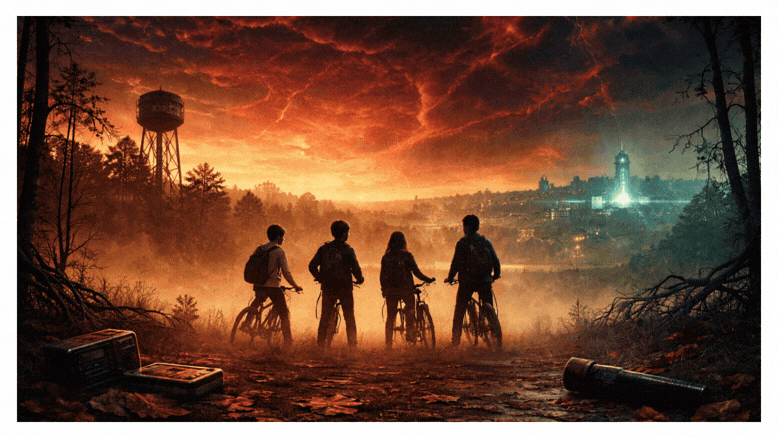
Stranger Things never felt like just another Netflix series to me. From the very first season, it existed in a space that was neither fully fictional nor entirely implausible, a liminal zone between nostalgia and fear, childhood innocence and adult trauma, science and something far more ancient. Now that the series has come to an end, what lingers isn’t merely the memory of monsters or parallel worlds, but the emotional weight of growing up together in uncertainty.
At its core, Stranger Things is about thresholds—moments when one reality slips into another. And perhaps that’s why it resonated so deeply across generations who may not have lived in the decades it portrays, yet feel inexplicably nostalgic for them.
The Emotional Architecture of Growing Up in Stranger Things
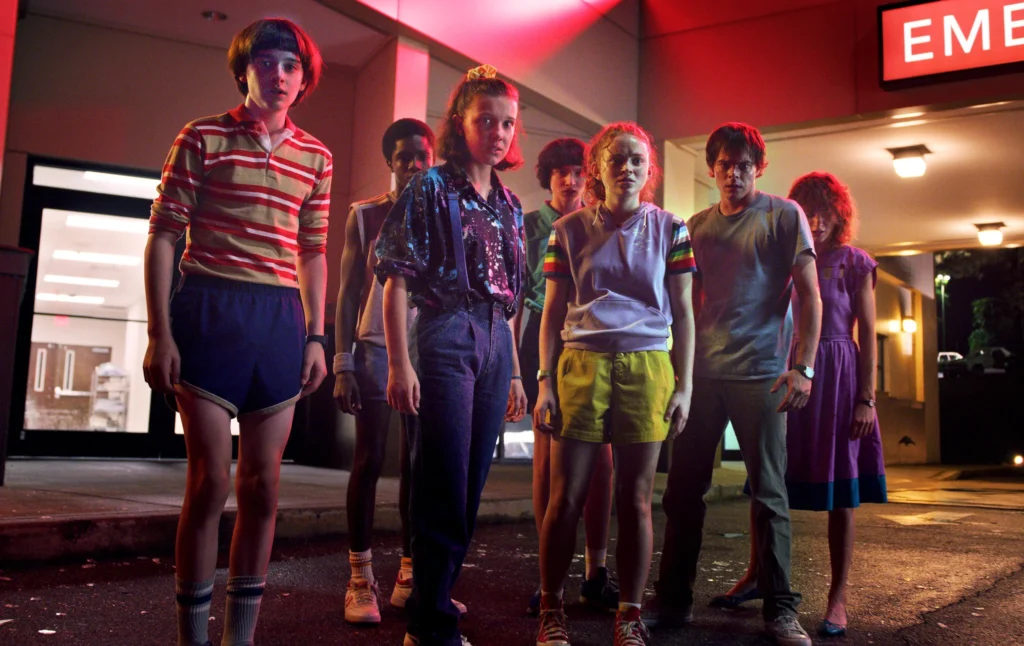
What truly anchored Stranger Things was not the supernatural threat of the Upside Down, but the emotional architecture of its characters. A group of children bound by friendship, secrecy, and shared trauma slowly growing into adolescence, and then adulthood—mirrored something deeply familiar.
Their bond felt real because it was forged under pressure. Loss, fear, abandonment, and silence became the glue. This wasn’t friendship as seen through a glossy, aspirational lens, but friendship as survival. Watching them grow up together felt almost intrusive at times, as though we were witnessing private emotional negotiations between bravery and fear, loyalty and self-preservation.
There’s something unsettlingly honest about that. Trauma doesn’t always destroy; sometimes it creates lifelong alliances. The Netflix series captured that uncomfortable balance with rare emotional intelligence.
Nostalgia and the Romance of the Analogue World
The retro aesthetic of Stranger Things was never just visual styling; it was emotional storytelling. While the series is rooted in the 70s and 80s, a time many of its audience never lived; it still feels strangely familiar, especially to millennials who grew up in the 90s, experiencing echoes of that analogue world.
Racing bicycles until sunset, sharing CDs and video games, recording mixtapes, waiting by landlines, passing handwritten notes—these were not distant relics, but lived experiences. Communication required presence. Friendship demanded effort.
Stranger Things doesn’t recreate our childhoods exactly; it amplifies them, romanticising a slower rhythm of connection that existed before life was fully absorbed into the algorithmic matrix, where connection is constant, but intimacy is increasingly diluted.
For Gen Z, this world feels almost mythical. For millennials, it feels transitional, a bridge between tactile intimacy and digital saturation. The series taps into a collective memory of when communication required presence, patience, and trust. That analogue romance now feels precious precisely because of how radically things have changed.
Fashion, music, and technology in the series were not costumes; they were cultural cues pointing to a time when identity formation happened offline, through physical presence and shared experiences. That analogue world becomes almost sacred in retrospect—a reminder that human connection once relied more on trust than surveillance.
Science and the Question of Parallel Worlds
Science fiction in Stranger Things functions less as spectacle and more as suggestion. Parallel dimensions, altered consciousness, and non-linear time are presented not as abstract theories, but as dark reflections of the known world—possibilities hovering just beyond comprehension.
The Upside Down felt less like an alien planet and more like a psychological realm: suppressed, decaying, and frozen in time. Modern science continues to explore ideas of multiple dimensions and altered states of awareness, questioning whether time and perception are as fixed as we assume. When fiction aligns too closely with research, it naturally unsettles us.
What makes it more disturbing is the subtle suggestion that institutions, labs, governments, or secret services may have always experimented on the edge of ethical boundaries. The idea that Hawkins Lab echoes real-world histories isn’t meant to provoke paranoia, but reflection. Power, when combined with curiosity and control, has always tested moral boundaries. The true horror lies not in the supernatural, but in human ambition.
Stranger Things Through a Vedic and Philosophical Lens
From a Vedic perspective, the idea of multiple lokas (realms) existing simultaneously isn’t new. Ancient texts spoke of dimensions layered upon each other, some visible, others accessible only through altered perception, discipline, or clairvoyance.
In that sense, Stranger Things feels less like a modern invention and more like a reinterpretation. Science and Religion, often positioned as opposites, appear here as parallel paths seeking the same truth, one through data, the other through introspection.
Children in the series often act as liminal beings—more intuitive, more open, less conditioned by rigid logic. Their ability to sense, access, or survive these other worlds hints at a loss we experience with age: intuitive knowing. Growing up, we trade perception for certainty, imagination for structure, but often at the cost of awareness.
Trauma and the Psychology of the Vecna
Vecna is one of the most psychologically compelling antagonists in recent television, not because he is powerful, but because he is wounded. His story is less about evil and more about what happens when pain is seen but not guided, when intelligence is nurtured without emotional containment.
From a psychological standpoint, he represents the shadow self—the parts of consciousness that grow distorted when isolated. Power without balance becomes destructive. Trauma without integration becomes obsession.
What makes Vecna unsettling is not his monstrosity, but his familiarity. He is not merely Eleven’s antagonist, but her cautionary mirror. He represents what she could have become without support, friendship, and choice.
The Unfinished Nature of Reality
The ending of Stranger Things didn’t offer closure in the traditional sense. Instead, it left us with a quiet unease, and that feels intentional. Some stories aren’t meant to end neatly because reality doesn’t.
There’s a lingering sense that this world could reopen—if not as a sequel, then as an idea. Stories like these return every few decades because each generation re-enters the same questions: How much should we know? How much power is too much? What happens when curiosity outruns ethics?
Hope exists, but it’s fragile. Reflection is necessary, but uncomfortable. The future, like the series itself, remains uncertain.
Stranger Things and Liminal Reflections
Perhaps Stranger Things mattered because it refused to stay in one category. It existed between nostalgia and fear, science and spirituality, childhood wonder and adult disillusionment. It acknowledged that balance is not about certainty, but coexistence.
In a world increasingly obsessed with absolutes, Stranger Things stayed in the in-between—where meaning is fluid, answers are incomplete, and growth is ongoing. It reminds us that some stories are not meant to explain reality, but to reflect it to us, distorted yet recognisable.
And maybe that’s why it lingers. Not because it gave us answers, but because it asked the right questions, and left us standing at the threshold, still looking.