
The art of creativity is often associated with talent, inspiration, or the rare ability to produce something original. We admire paintings that redefine artistic movements, campaigns that shape culture, and designs that seem years ahead of their time, yet rarely pause to consider what happens before those ideas take form. Behind every finished piece lies a quieter process—one built on observation, curiosity, experience, and the ability to connect seemingly unrelated ideas.
Popular culture has long romanticised creativity. Films celebrate the moment of inspiration, social media showcases polished outcomes, and history often remembers the masterpiece rather than the years that led to it. While those moments deserve recognition, they reveal only part of the story. The creative process begins long before the first sketch, sentence, sculpture, or photograph. More often than not, it starts with learning how to see.
This article isn’t a guide filled with productivity techniques or promises of becoming “more creative” overnight. Instead, it’s an exploration of the art of creativity itself—why it matters, how it develops, and why observation remains one of the most valuable skills across every creative discipline.
Why We Often Mistake the Art of Creativity for Talent
Ask someone to describe a creative person, and the answer is usually immediate. An artist, a musician, a filmmaker, or perhaps an inventor comes to mind. The assumption is often the same: creativity is something a fortunate few are born with.
Although natural ability certainly exists, talent alone rarely explains meaningful creative work. A photographer may spend hours waiting for the perfect light, while a designer studies materials, proportion, and context before creating a single concept. Writers collect conversations, architects examine how people move through space, and illustrators fill pages with rough sketches that never reach the final audience.
The visible outcome is only one part of the process. Everything that happens beforehand—the research, the observation, the experimentation, and even the failed attempts—quietly shapes the finished work.
Perhaps the art of creativity is less about extraordinary moments of inspiration and more about developing extraordinary habits of attention.
Seeing Is Different from Looking
Observation is often described as the foundation of creativity, but what separates seeing from simply looking?
Looking is automatic. It’s how we navigate familiar streets, scroll through images, or pass by buildings without giving them much thought. Seeing, on the other hand, asks for something more intentional. It invites us to notice relationships, textures, emotions, contrasts, and details that routine would otherwise hide.
The difference may appear subtle, yet it transforms the way creative people approach the world.
Consider the way painters study changing light rather than objects alone. A street photographer anticipates human interaction before pressing the shutter. Designers pay attention to how people behave instead of relying solely on aesthetics, while writers often find stories in ordinary conversations that others quickly forget.
None of these observations guarantees a creative outcome.
They simply provide richer material from which ideas can grow.
Every Art Movement Changed the Way We See
Art history offers countless examples of creativity reshaping perception rather than merely producing beautiful objects.
The dramatic use of chiaroscuro transformed light and shadow into emotional storytelling instead of technical precision. Impressionism encouraged artists to capture fleeting moments rather than perfect detail, while expressionism placed emotion above objective reality. Later, cubism challenged the idea that a single viewpoint could fully represent the world, and surrealism explored the space between dreams, memory, and the subconscious.
Although each movement introduced a distinct visual language, they all shared something in common: a willingness to question existing ways of seeing.
That may be one of art’s greatest contributions. It doesn’t simply document history—it expands our understanding of perspective.
If Original Ideas Are Rare, Where Do They Come From?
One of the biggest myths surrounding creativity is the belief that original ideas appear from nowhere.
In reality, most creative breakthroughs emerge through connection rather than invention.
History, psychology, architecture, fashion, literature, travel, science, and everyday experiences all become part of an evolving mental archive. Over time, unexpected relationships begin to form between subjects that once seemed entirely unrelated.
A branding project may borrow principles from museum curation. Architectural forms often echo patterns found in nature. Fashion has repeatedly drawn inspiration from art movements, cultural traditions, and social change. Even a conversation overheard during a journey can quietly influence a future piece of writing.
The ability to recognise those connections is what makes creative thinking feel original.
Instead of searching endlessly for new ideas, experienced creators often become better at discovering new relationships between existing ones.
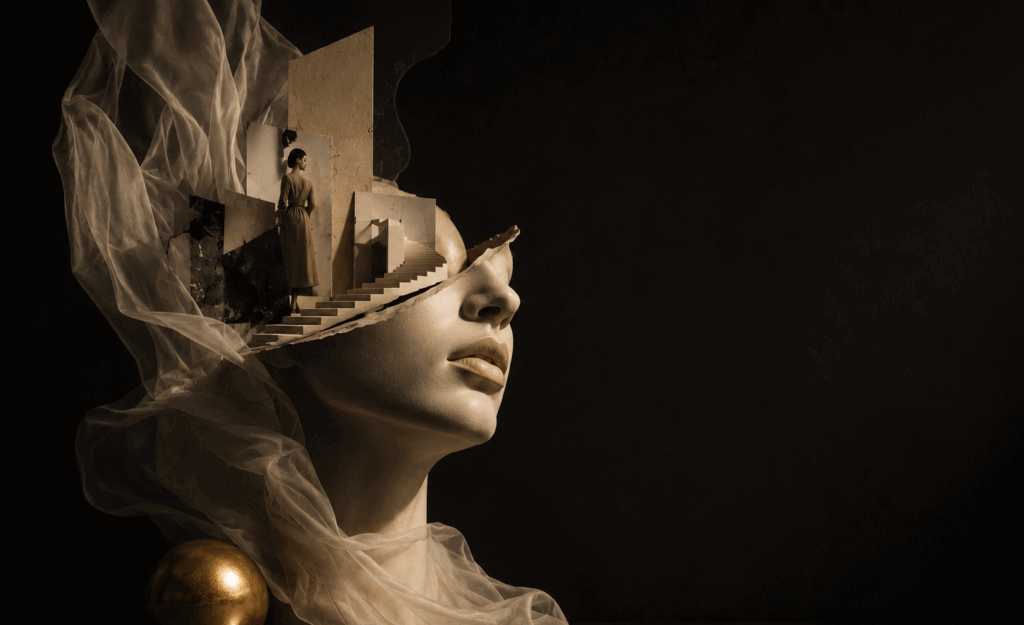
Curiosity Gives Creativity Direction
If observation gathers information, curiosity determines where that information leads.
Questions drive every creative discipline, though they rarely sound the same.
Why did one design become timeless while another disappeared?
What makes certain public spaces feel welcoming?
How does colour influence emotion across different cultures?
Why do some visual symbols survive for centuries while others fade within a decade?
These questions don’t always produce immediate answers, nor should they. Their value lies in encouraging exploration rather than certainty.
Over time, curiosity develops something more important than knowledge alone: perspective.
How Different Creative Fields Teach Us to See
One reason the art of creativity is so difficult to define is that each discipline develops observation in its own way.
Fine art encourages sensitivity to composition, light, balance, and emotion. Photography trains patience, asking practitioners to anticipate moments instead of simply recording them. Design introduces constraints, reminding us that creativity often flourishes within limitations rather than unlimited freedom.
Fashion offers another perspective entirely. Clothing communicates identity, history, craftsmanship, and cultural change long before a garment reaches the runway. Architecture reveals how environments shape behaviour, while branding explores the relationship between symbols, language, and human perception.
Viewed together, these disciplines suggest that creativity isn’t confined to one profession or medium.
What changes is the method.
The habit of learning to see remains remarkably consistent.
Creating in an Age of Endless Images
Today’s creative landscape offers more access to visual inspiration than any generation before it.
Within seconds, we can explore museum collections, discover emerging artists, analyse global campaigns, or experiment with AI art using tools that would have seemed impossible only a few years ago.
Abundance, however, doesn’t automatically produce originality.
Technology can accelerate creation, but it cannot determine what deserves our attention. Algorithms recommend content based on familiarity, whereas meaningful creativity often grows from curiosity, lived experience, and the willingness to look beyond what is immediately visible.
As creative tools continue to evolve, perspective may become even more valuable than production itself.
When Creativity Becomes Culture
Art has never existed solely within galleries or museums.
Throughout history, it has shaped conversations, challenged authority, documented social movements, and reflected the values of different generations. Political art questions power structures, public murals transform shared spaces, and sculpture changes the way we experience architecture and landscape.
Creative expression continues to evolve alongside society because culture itself is never static.
New technologies introduce fresh possibilities. Communities reinterpret traditions. Artists respond to changing realities through materials, ideas, and visual language.
It’s a subject I explore further in “Art and the Shifting Language of Human Expression,” but the central idea remains the same: creativity doesn’t exist outside culture—it grows with it.
Before We Create, We Learn to See
The more we celebrate finished work, the easier it becomes to overlook everything that made it possible.
Every painting begins with observation before technique. Every design starts with research before refinement. Every compelling story develops through lived experience before it reaches the page.
The art of creativity isn’t simply about producing something original.
It’s about developing the patience to observe, the curiosity to explore unfamiliar ideas, and the awareness to recognise connections that others might miss.
Perhaps that’s why creativity continues to fascinate us across every generation. Although the tools, mediums, and technologies continue to change, the foundation remains surprisingly familiar.
Meaningful ideas rarely begin with certainty.
They begin with someone paying close enough attention to see the world a little differently.