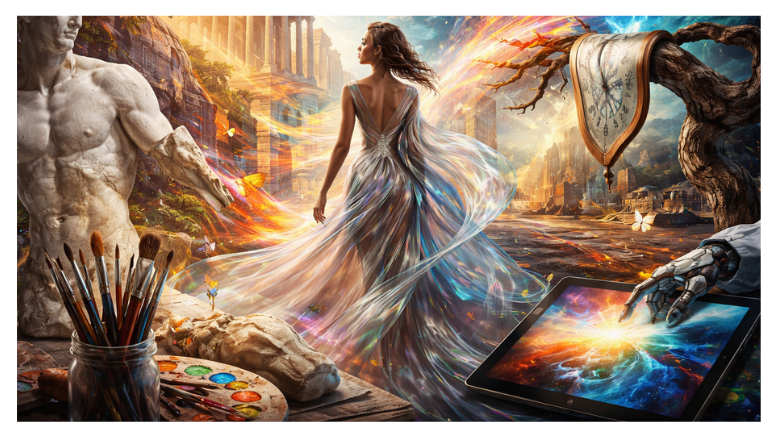
Art has never belonged to a single definition. Across centuries, artists have created not only new styles but entirely new ways of understanding what art itself could be. From the anatomical precision of ancient sculpture to the fragmented geometry of Cubism, from the dreamlike landscapes of Salvador Dalí’s surrealism to the algorithmic experiments of AI-generated images, art continues to evolve with human imagination.
Yet beyond movements and techniques, art has always been something deeper. It often becomes the language of those who cannot easily articulate their thoughts in crowded rooms — a quiet rebellion, a reflection of identity, or simply an attempt to make sense of the world. To understand art, therefore, is not merely to observe objects or images. It is to explore how human beings have continuously reshaped visual language to express emotion, belief, resistance, and curiosity across generations.
And perhaps that is what makes art endlessly fascinating: every era believes it has redefined creativity, yet art simply shifts its language and continues speaking.
Art as a Language Beyond Words
Before art was categorised into movements or institutions, it existed as instinct. Long before galleries, algorithms, or even written language, humans painted stories on cave walls, carved figures into stone, and shaped objects that carried symbolic meaning.
In many ways, art continues to function as a parallel language. Some people write essays; others compose music; others translate their emotions into colour, form, or texture. For those who struggle to communicate their inner worlds through conventional speech, art becomes both a refuge and a voice.
Certain works resonate across centuries precisely because they capture emotions that remain universally human. Edvard Munch’s The Scream, for example, is often interpreted as a visual representation of existential anxiety. The distorted figure and swirling sky may belong to the late nineteenth century, yet the emotion it communicates — the overwhelming intensity of being alive in a chaotic world — feels strangely contemporary.
Perhaps this is the quiet power of art: it allows emotions to survive long after the moment that produced them has passed.
Art Across Time: The Evolution of Creative Expression
The history of art is not a straight line but a series of shifts in perception. Each era redefines how reality should be interpreted visually.
One of the earliest and most enduring traditions is sculpture art. Across both Eastern and Western civilisations, sculptural forms have played a central role in shaping cultural identity and spiritual narratives. From the marble figures of ancient Greece to the intricate stone carvings found in Indian temples, sculpture often functioned as a bridge between art, architecture, and belief.
Temples across India and Southeast Asia feature elaborate sculptural reliefs that narrate mythology and philosophy through stone. Similarly, European cathedrals and palaces integrated sculpture to symbolise power, divinity, and beauty. Whether carved into temple walls or placed within palace courtyards, these works demonstrate how sculpture transformed physical spaces into cultural storytelling.
As centuries progressed, artistic interpretation began shifting away from purely naturalistic representation.
In the late nineteenth century, Impressionism introduced a radical departure from academic painting. For example, Claude Monet began capturing fleeting impressions of light and atmosphere rather than precise details of objects.
Soon after, Expressionism emerged, prioritising emotional intensity over visual accuracy. Edvard Munch distorted colour and form to communicate psychological experiences rather than physical reality.
These developments reveal something important: art evolves whenever artists begin questioning how the world should be represented.
Movements That Redefined Artistic Perception
Some artistic movements do more than introduce new techniques; they fundamentally alter how people see.
Cubism, pioneered by Pablo Picasso and Georges Braque, fragmented perspective, allowing objects to be viewed simultaneously from multiple angles. Instead of representing a single moment in time, Cubist paintings presented multiple viewpoints within one composition.
Surrealism ventured even deeper into the subconscious. The iconic Salvador Dalí transformed dreams, symbols, and irrational juxtapositions into visual narratives. Melting clocks, impossible landscapes, and distorted forms created a world where logic temporarily stepped aside.
Meanwhile, the abstract art movement proved that art did not need to represent recognisable objects at all. Artists like Wassily Kandinsky and Piet Mondrian demonstrated that colour, line, and composition alone could evoke emotion and meaning.
Art also became a powerful bureaucratic instrument. Political art movements throughout the twentieth century used imagery to critique authority, expose social injustice, and mobilise public consciousness. From revolutionary posters to conceptual installations, art often served as both a cultural mirror and a social commentary.
Together, these movements expanded the vocabulary of visual expression, reminding us that artistic language evolves whenever artists challenge existing conventions.
Mediums of Creativity: From Canvas to Algorithms
Artistic language is shaped not only by ideas but also by the mediums through which those ideas are expressed.
Traditional mediums such as painting and sculpture continue to hold an enduring presence in artistic practice. The tactile relationship between artist and material — brush against canvas, chisel against stone — often becomes part of the creative narrative itself.
In my own practice, for instance, I often experiment with black-and-white canvas paintings inspired by chiaroscuro techniques, where dramatic contrasts of light and shadow create depth and emotional tension. Translating this classical method into abstract, expressionist, or surreal compositions allows light itself to become a storytelling device.
But contemporary art rarely confines itself to traditional materials. Digital tools such as Procreate, Blender, Midjourney, and other algorithm-assisted platforms allow artists to visualise ideas in ways that were technically impossible just a few decades ago.
Alongside these tools, entirely new artistic practices have emerged. Pixel-based art, 3D modelling, generative design, immersive installations, and AI-assisted imagery have expanded the boundaries of creative experimentation. Naturally, this raises curious questions: can pixels succeed paint? Can code or algorithms replicate intuition?
Perhaps the more interesting perspective is that each new medium simply adds another dialect to the evolving language of art.
Art, Design, and Fashion
The boundary between art and design has always been fluid.
While design traditionally prioritises function, art privileges expression. Yet the two frequently overlap, borrowing from each other’s visual vocabulary.
Fashion, in particular, exists at a fascinating intersection of art, design, and cultural storytelling.
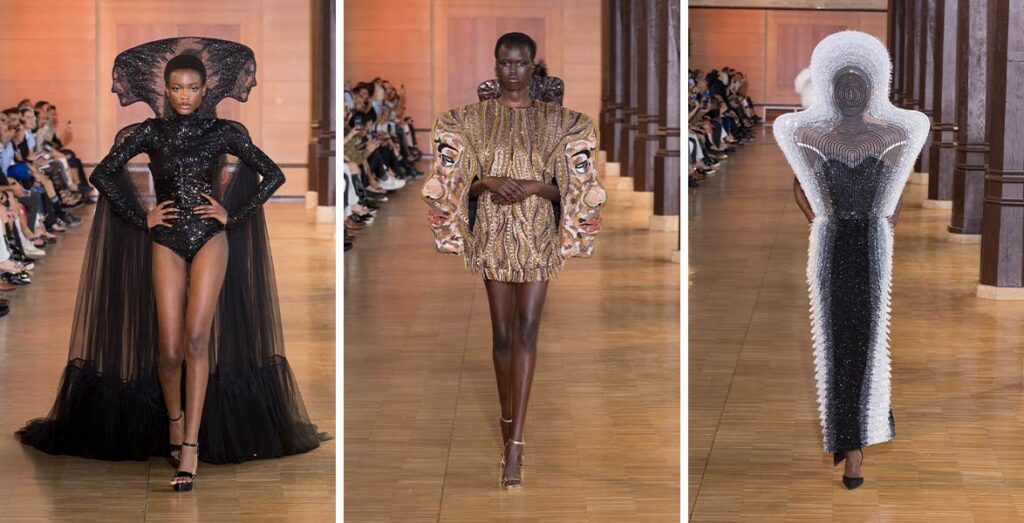
Designers such as Issey Miyake transformed textile innovation into artistic experimentation in the late 1980s, continuing to evolve through advanced techniques like his 3D steam stretch pleating by the 2010s. Elsa Schiaparelli, heavily influenced by surrealism, collaborated with artists like Salvador Dalí to produce garments that blurred the boundaries between fashion and conceptual art. Alexander McQueen pushed this dialogue even further with theatrical runway presentations that often resembled performance art.
Contemporary designers continue this tradition. Iris van Herpen, for instance, pushes the boundaries of fashion through experimental materials, 3D printing, and sculptural silhouettes that blur the line between garment and installation. Rahul Mishra integrates intricate hand embroidery into garments that resemble living canvases, while Sabyasachi Mukherjee merges heritage craftsmanship with artistic narrative, transforming traditional textiles into cultural storytelling.
In such contexts, luxury fashion becomes more than clothing; it becomes a medium through which art enters everyday life.
The Democratisation of Art in the Age of AI
Artificial intelligence has introduced one of the most intriguing shifts in contemporary creative culture.
Today, individuals with little to no formal training in traditional art techniques can generate visually striking images using AI-powered tools. This accessibility has undoubtedly democratised artistic participation. Ideas that once remained trapped in imagination can now be visualised within seconds.
Yet this transformation also introduces subtle complexities.
Creating an image does not automatically translate into understanding art. The interpretation of symbolism, cultural references, historical movements, and visual theory still requires curiosity and learning.
In this sense, the role of the artist and the art lover may become even more interesting in the AI era. Algorithms may assist with image generation, but they do not automatically inherit the centuries of thought, philosophy, and experimentation that shaped artistic traditions.
The conversation, therefore, shifts from who can create images to how we interpret and understand them.
AI art may accelerate visual production, but artistic perspective — the ability to contextualise images within culture, history, and emotion — remains deeply human.
Why Art Continues to Matter
Despite evolving tools and cultural shifts, the essence of art remains remarkably resilient.
Art continues to provide a space where ideas can exist without immediate explanation. It allows individuals to explore identity, question authority, document history, and imagine alternative futures.
A sculpture carved centuries ago can still inspire awe within a temple courtyard. A surreal painting can invite viewers into dreamlike psychological landscapes. A runway collection can translate cultural memory into wearable narratives. Even a digitally generated image can spark curiosity about the possibilities of creativity.
What changes is not the purpose of art, but the language through which it speaks.
From stone carvings in ancient temples to the fractured geometry of Cubism, from the emotional intensity of Expressionism to the algorithmic experiments of AI-generated imagery, art continues to evolve alongside human thought.
Its mediums may shift, its techniques may transform, and its platforms may multiply — but the human impulse behind it remains familiar.
Art, in the end, is simply humanity thinking out loud in visual form.