
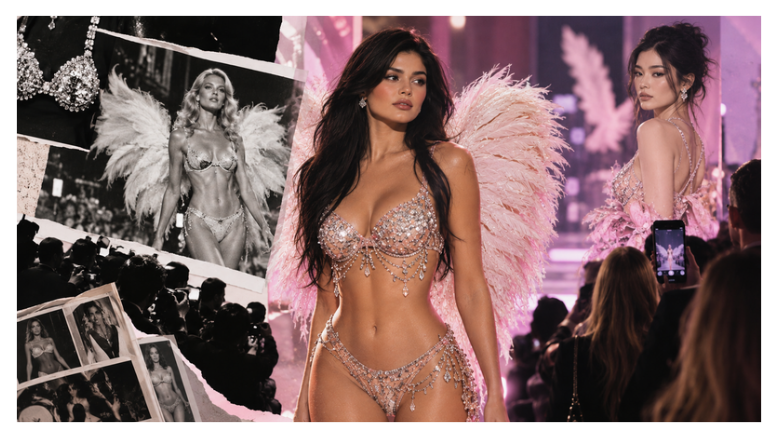
Victoria’s Secret has always understood that selling lingerie means selling more than lingerie. At its cultural peak, the brand offered an elaborate fantasy: towering wings, extravagant costumes, supermodels with rock-star charisma, and a runway spectacle that turned underwear into an event. The annual Victoria’s Secret Fashion Show was never simply about lingerie; it was about spectacle, aspiration and a particular moment in popular culture.
On 18 October 2026, the show returned to Los Angeles with its familiar theatricality. But the revival of the Fantasy Bra, absent from the runway since 2018, became one of the evening’s most debated moments. Valued at a reported $50 million, the diamond-encrusted creation was worn by Kylie Jenner, making her Victoria’s Secret runway debut. The brand had restored one of its most recognisable symbols of prestige, only to place it on a celebrity whose fame preceded her association with the runway. Vogue, 2026.
The decision makes commercial sense. Jenner brings enormous visibility and an audience extending well beyond fashion. Yet it raises a more interesting question: when a brand revives its most prestigious symbol, should its priority be maximising attention or preserving the legacy that made the symbol matter?
This is not an argument against Kylie Jenner, celebrity casting or fresh faces. It is about what happens when a brand attempts to recover its cultural authority by reproducing the imagery of its golden era while changing the dynamics that gave those images meaning.
You can bring back the Wings. You can bring back the Angels. You can bring back the Fantasy Bra. But can you bring back the cultural relevance?
Or are we simply being sold our own memories?
Victoria’s Secret and the Art of Selling a Fantasy
The show’s appeal lay in its excess. The wings were theatrical, the embellishments unapologetic, and the models were presented as characters within a carefully constructed brand mythology. Victoria’s Secret understood how to turn a product category into an occasion.
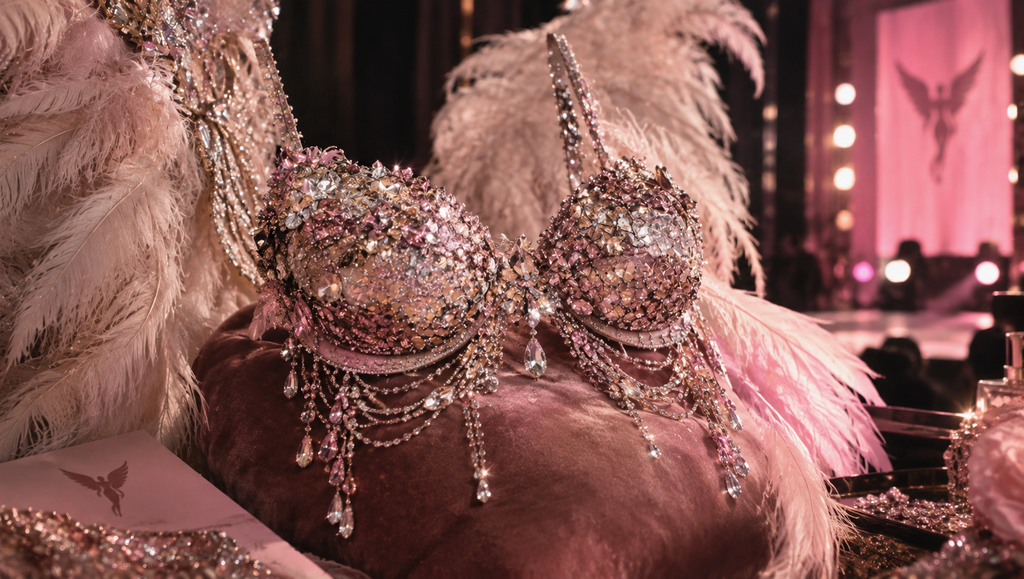
The Fantasy Bra was the ultimate expression of that ambition. First introduced in 1996, with Claudia Schiffer modelling the Million Dollar Miracle Bra, it transformed lingerie into a high-jewellery spectacle. Subsequent versions became associated with established Angels, including Heidi Klum and Gisele Bündchen. Elsa Hosk wore the last runway Fantasy Bra in 2018. People, 2026.
The bra was never merely an expensive garment. Its significance came from the relationship between the craftsmanship, the model and the mythology surrounding the show. Its extraordinary price was part of the performance, but so was the identity of the woman wearing it.
The show was always commercial, of course. Yet there was a difference between selling a product through spectacle and creating a spectacle that became a cultural event in its own right. Victoria’s Secret managed to do both.
That is precisely what its revival must confront. Reproducing the visual language of the past is relatively easy. Recreating the circumstances that made people care about it is considerably harder.
The Fantasy Bra, Kylie Jenner and the Price of Prestige
The Fantasy Bra was never a formal industry award, nor was there a published set of objective criteria determining who deserved to wear it. Nevertheless, its association with established Angels gave the selection a particular symbolic weight. The bra represented the pinnacle of the Victoria’s Secret fantasy, embodied by models who had helped build its mythology.
Kylie Jenner’s casting selection challenges that tradition. The issue is not whether she deserves her success, or whether she can attract an audience. It is that she wore the Fantasy Bra on her debut, while established models spent years building their association with the brand.
Commercially, the choice is understandable. Culturally, it is more complicated.
The relationship between the brand and its models has effectively been reversed. Rather than Victoria’s Secret helping to turn a model into a household name, it has borrowed an existing celebrity’s influence to amplify its own comeback.
A reported $50 million price tag can establish a garment’s extravagance. It cannot, by itself, establish the cultural significance of the person wearing it. Cost and prestige are not interchangeable: one is a monetary figure, the other a relationship between history, perception and recognition.
There is no reason the Fantasy Bra must remain exclusive to veteran Angels, or that celebrity casting should be ruled out. But if the tradition is to evolve, the brand needs to communicate what the distinction represents now. Is it a celebration of modelling, a recognition of contemporary cultural influence, or simply an effective marketing placement?
Those objectives can overlap, but they are not the same. The risk is that the Fantasy Bra remains spectacular while its meaning becomes less distinctive.
From the Front Row to the For You Page
The controversy reflects a broader transformation in fashion. Fashion editors, buyers, critics and industry insiders once dominated the front rows at major shows, signalling professional recognition. Celebrities were always part of the picture, but the front row also brought together people who interpreted collections, influenced retail decisions and shaped fashion discourse.
Today, influencers and content creators share that space with editors, buyers and established industry figures. Their reach can introduce designers to audiences who might never read a fashion magazine or follow the traditional fashion calendar. That is a genuine change in how fashion is discovered and discussed.
But visibility, expertise and cultural understanding are not interchangeable.
Someone can have millions of followers without possessing a deep understanding of fashion history, garment construction or design movements. Equally, an influencer can be knowledgeable, thoughtful and genuinely influential beyond their audience numbers. The problem is not the presence of creators; it is the tendency to treat reach as a substitute for every other form of value.
In an industry increasingly driven by online attention, the front row itself has become content. Celebrity arrivals circulate before collections are properly examined, and a viral outfit can overshadow the creative work that justified the invitation.
Fashion has always been shaped by status-driven culture, but status once depended on more than name recognition. It also rested on discernment, professional credibility and the ability to interpret what the industry presented.
The Devil Wears Prada may have dramatised the authority of the traditional fashion editor, but it understood something fundamental: fashion is not only about what is visible. It is also about who gets to interpret what is visible, and whose interpretation carries weight.
The industry has made fashion more accessible to participate in. That does not mean expertise has become irrelevant. Everyone can publish an opinion; not every opinion demonstrates the same depth of knowledge.
The question is whether fashion still wants to create its own icons, or whether it increasingly prefers to borrow the attention of people who already have them.
Nostalgia Is Not Cultural Relevance
Nostalgia works because it offers recognition. A familiar silhouette, a pair of wings or the return of a long-absent runway tradition can reconnect audiences with a period of their lives and the cultural imagery associated with it.
For Victoria’s Secret, reviving the Fantasy Bra was an invitation to revisit an era when the show occupied a distinctive place in popular culture. The brand did not have to build every association from scratch; its audience already carried memories of the spectacle.
But recognition is not relevance.
The original show emerged in a media environment shaped by broadcast television, fashion magazines and a relatively concentrated celebrity culture. Today, audiences are fragmented across platforms, personalities and communities. A show can trend without becoming a lasting cultural landmark. A celebrity can dominate the conversation without making the brand itself more meaningful.
This is where consumer psychology becomes relevant. Nostalgia can renew emotional attachment and encourage audiences to revisit a brand, but it cannot guarantee that the brand has something meaningful to offer the present.
Does the show give a new generation a reason to care beyond the novelty of the wings? Or does it influence fashion and popular culture beyond the immediate event? Does Victoria’s Secret have a distinctive point of view that extends beyond its archival imagery?
These are harder questions than whether the costumes look spectacular. They are also more consequential.
Nostalgia can open the door to renewed relevance. It cannot walk through that door on a brand’s behalf.
Victoria’s Secret Reinvention, Representation, and the Politics of the Past
Victoria’s Secret cannot be discussed honestly without acknowledging the crisis that preceded the show’s disappearance. In 2018, former chief marketing officer Ed Razek faced widespread criticism for comments about transgender and plus-size models. Amid growing scrutiny of the brand’s direction and narrow representation of beauty, Victoria’s Secret discontinued the annual show in 2019. The show returned in 2024 with a different approach to casting and presentation.
The intervening years mattered. The brand could not simply resume its former position as though cultural expectations had stood still. Its return required a new relationship with audiences who had become more critical of representation, identity and the assumptions behind fashion’s traditional ideals.
Yet reinvention presents a familiar dilemma: how much must a brand change to remain credible without losing the qualities that made it recognisable?
Fashion houses across London and Milan regularly revisit their archives, reviving familiar codes for contemporary audiences. Heritage can provide identity, but it becomes limiting when it substitutes for creative direction. The same tension appears in fashion geopolitics, where historical symbols and cultural narratives are continually reinterpreted to serve the needs of the present.
There is a subtle parallel here with the wider appeal of idealised pasts. In periods of cultural uncertainty, familiar imagery can offer reassurance. But nostalgia can also obscure the exclusions and contradictions that shaped the original era.
Victoria’s Secret does not need to choose between its past and its present. It can embrace new faces without discarding the professional legacy of its Angels. Broaden representation without abandoning theatricality. And it can work with celebrities without treating celebrity status as the only qualification that matters.
The challenge is to make those elements coexist convincingly, rather than simply appearing to change without a clear purpose.
Can Victoria’s Secret Make History Again?
The temptation to measure a comeback through headlines, viral moments and celebrity appearances is understandable. By those immediate standards, the return has certainly created a moment. But cultural relevance is a longer test.
It requires more than a successful event. It requires the ability to influence how people think about a brand, what they associate with it and why they continue to care after the spectacle ends.
Victoria’s Secret could begin by treating the runway as more than a celebrity-led entertainment event: investing in compelling design narratives, respecting the history of its models and giving audiences a reason to engage beyond the novelty of an expensive garment. It could balance contemporary reach with fashion knowledge, rather than assuming the two are interchangeable.
None of this requires a return to exclusionary beauty ideals or a rejection of influencer culture. Fashion has always evolved through the interaction of creativity, commerce and popular taste. The challenge is to ensure that one does not overwhelm the others.
From the front rows of London, Milan and Paris to the endlessly scrolling digital landscape, fashion has always negotiated the relationship between appearance and meaning. It is a tension that also runs through The Devil Wears Prada and Style, Sight and the Self: what we see, what we value, and the cultural systems that teach us to distinguish one from the other.
Victoria’s Secret has reminded us that it knows how to sell a fantasy. Whether it can create one that belongs to the present remains to be seen.
Nostalgia can remind us why something once mattered. It cannot, on its own, make it matter again.