
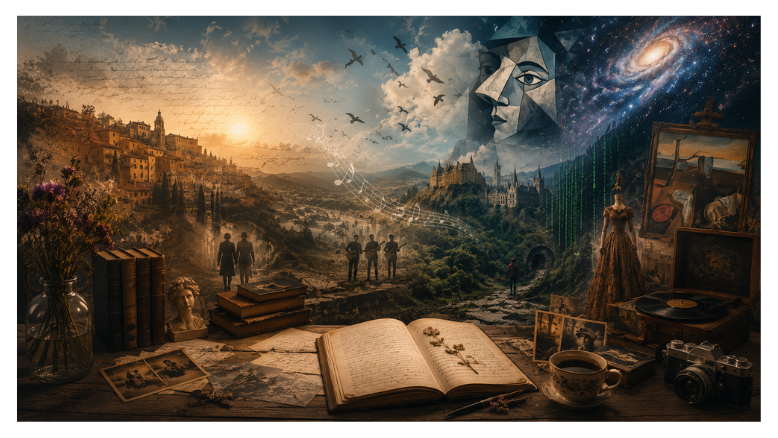
Memory is one of humanity’s oldest storytellers. It lingers in the places we return to, the songs we instinctively hum, the books we revisit and the photographs we keep long after their colours have faded. Yet memory is rarely a perfect record of the past. It softens some moments, sharpens others and quietly leaves space for imagination to complete what time cannot preserve. Perhaps that is why our greatest stories, paintings, poems and performances continue to resonate—not because they remember everything exactly as it happened, but because they capture something deeper than fact: what it felt like to be human.
Memory Begins Before We Do
Memory is often mistaken for a personal archive—a carefully organised collection of moments we revisit whenever nostalgia comes knocking. In reality, memory is far less obedient. It forgets details, embellishes emotions, rearranges timelines and occasionally convinces us that something happened exactly as we remember it, even when it didn’t.
Perhaps that is why memory has always needed imagination.
Without imagination, memory remains private. It exists only within the individual. But once memory is transformed into a story, a painting, a poem, a song, a performance or even a beautifully tailored garment, it begins a second life—one that no longer belongs solely to its creator.
This is where creativity becomes remarkable.
Every civilisation has found a way to preserve what mattered most. Before libraries came oral traditions. Before photography came cave paintings. Before digital archives came letters, journals, folk songs and theatre. Humans have always sought to leave traces of themselves behind—not because memory is perfect, but because it isn’t.
Perhaps what we call culture is simply memory that has learned to travel.
When Memory Becomes Expression
Long before creativity became an industry, it was a necessity.
Stories helped communities remember their origins. Songs preserved histories that were never written down. Paintings documented victories, grief, devotion and everyday life. Performance allowed societies to question power, celebrate rituals and pass wisdom from one generation to another.
This idea echoes one explored in Art and the Shifting Language of Human Expression—that art evolves because human expression evolves. The mediums change; the impulse rarely does.
Whether carved into stone, written with ink or rendered digitally, creative expression answers the same question:
How do we make a fleeting human experience last a little longer?
Even places become part of this language. Think of Tuscany—not merely as rolling vineyards and Renaissance architecture, but as a landscape continually rewritten by painters, writers, filmmakers and travellers. Places become meaningful because memory accumulates there. Geography becomes narrative.
The same could be said of Edinburgh, where medieval closes, literary history and winding streets seem to invite stories before one has even begun to write them. Some cities are remembered because they existed. Others because imagination kept returning to them.
Stories Never Stay the Same
The most fascinating thing about stories is that they refuse to remain fixed.
A folktale told by a grandmother becomes slightly different when her granddaughter tells it years later.
A Shakespeare play performed in 17th-century London acquires new meanings on a 21st-century stage.
Rabindranath Tagore’s poetry continues speaking to readers living in entirely different worlds from the one in which it was written.
Every generation edits memory—not always deliberately, but inevitably.
That isn’t a flaw.
It’s how culture survives.
The same story gathers new questions because the people asking them have changed.
The same painting reveals different emotions because the viewer brings different experiences.
The same novel feels entirely different at sixteen than it does at thirty-five.
Memory isn’t preserved in amber.
It evolves with us.
Seeing Beyond What We Remember
Memory rarely arrives as a complete picture.
It comes in fragments.
A colour.
A melody.
A face.
A sentence.
The imagination quietly fills everything else.
Perhaps no artist understood this better than Salvador Dalí. The Persistence of Memory is remembered for its melting clocks, yet the painting is less about time than about our strangely elastic experience of it. Minutes can feel like hours; decades can disappear in an afternoon. Dalí painted not the mechanics of time, but the psychology of remembering.
Pablo Picasso approached memory differently. Through Cubism, he abandoned the idea that reality must be viewed from a single perspective. Faces fragmented into multiple angles. Objects appeared simultaneously from viewpoints that could never coexist.
Oddly enough, memory behaves much the same way.
We rarely remember a single moment exactly as it happened. We remember conversations alongside emotions, places alongside people, facts intertwined with feelings. Memory is often more Cubist than photographic.
Even the Italian Renaissance technique of chiaroscuro reminds us that light only gains meaning because of shadow. Some memories remain brilliantly illuminated. Others retreat into darkness until a familiar scent, an old photograph or an unexpected song draws them back into view.
The Stories We Wear, Watch and Hear
Creative expression isn’t confined to galleries and libraries.
Sometimes it walks the runway.
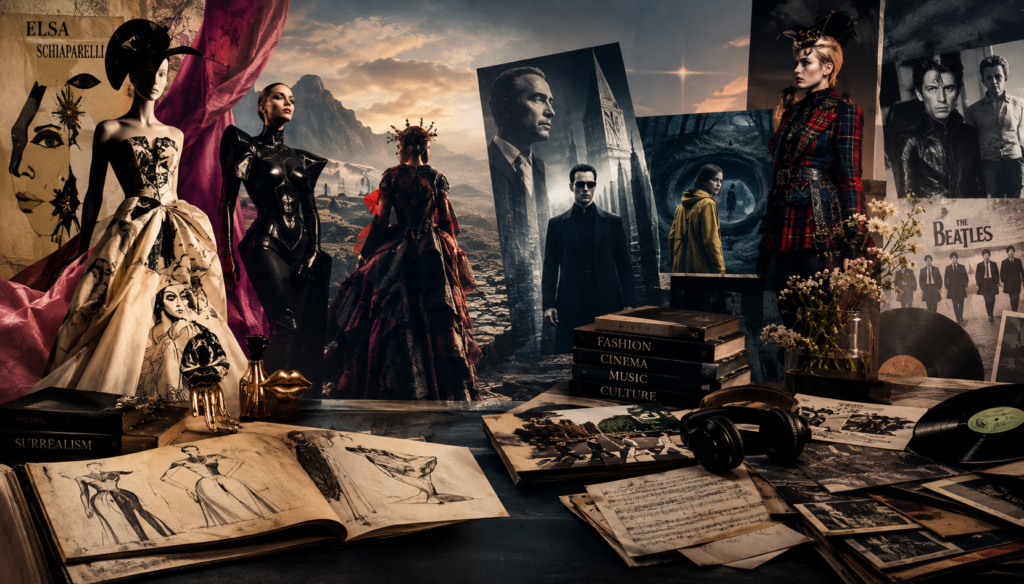
Fashion has always been dismissed too quickly as something merely decorative, yet the work of Elsa Schiaparelli, Thierry Mugler, Alexander McQueen, or Vivienne Westwood demonstrates the opposite.
McQueen turned historical trauma into theatrical collections.
Westwood stitched rebellion into tailoring.
Schiaparelli borrowed from Surrealism, transforming garments into conversations with artists like Dalí.
Mugler imagined futures that still influence designers decades later.
Clothing, much like literature, remembers.
It remembers cultures, revolutions, identities and aspirations.
Cinema performs a similar act.
The Matrix questioned whether reality itself could be trusted long before “simulation theory” became internet shorthand. The Netflix series, Dark, transformed memory into something almost architectural, asking whether identity survives when time itself collapses.
These stories don’t merely entertain.
They encourage critical thinking.
They remind us that imagination is not an escape from reality but often the most effective way of examining it.
Memory Has a Soundtrack
Few things unlock memory as effortlessly as music.
It takes only a few opening notes for decades to disappear.
Researchers have long observed that music holds a remarkable ability to unlock autobiographical memory. In fact, psychologists Shazia Akhtar, Martin Conway and their colleagues found that the songs people encounter during their formative years often become intertwined with their sense of identity—and that these musical memories are frequently passed from one generation to the next through families, shared listening and cultural experiences. In their 2024 study, the researchers described this intergenerational transmission as “cascading memories,” highlighting how music allows one generation’s experiences to become part of another’s story.
There is a reason why The Beatles’ In My Life continues to resonate nearly sixty years after Lennon and McCartney wrote it. The song is more than a nostalgic reflection; it reminds us that people, places and moments never disappear entirely. They settle into memory, quietly shaping who we are, and eventually become memories we share with others.
It isn’t simply a song about nostalgia.
It understands that people and places never really leave us; they continue existing in memory, quietly shaping who we become.
Pink Floyd’s Time, David Bowie’s Changes or Fleetwood Mac’s Landslide endure for similar reasons. Each generation discovers these songs anew. Not because they belong to a particular decade, but because growing older asks the same timeless questions—and the songs still have answers.
Music becomes memory long before we realise it has.
The Conversation We Continue
Every creative work begins somewhere.
But it rarely ends there.
A poet inspires another poet.
A filmmaker adapts a novel.
A designer revisits history.
A musician samples an older melody.
A child inherits a favourite book from a parent and discovers something entirely different within its pages.
This is perhaps the longest conversation humanity has ever had.
Not because everyone agrees.
But because everyone contributes.
The creative industry often celebrates originality, yet originality has never meant creating from nothing. It means entering a conversation already in progress and adding a perspective only you could have offered.
Every painting answers another painting.
Every story remembers another story.
Every generation leaves something unfinished for the next.
Where Memory Meets Imagination
Memory tells us where we have been.
Imagination asks where those memories might go next.
Some become novels.
Others become photographs tucked inside old books, family recipes scribbled onto fading paper, heirloom garments passed between generations or playlists that instantly transport us to another version of ourselves.
Most of us will never paint like Picasso, write like Tagore or compose songs that echo through stadiums. We don’t have to.
Every time we preserve a story, revisit a favourite film, recommend a book, inherit a piece of clothing, photograph an ordinary afternoon or write a journal entry that someone may one day discover, we participate in something much older than ourselves.
We become another voice in a conversation that refuses to end.
And somewhere between memory and imagination, something wonderfully human survives.
The way you describe memory as a storyteller really resonated with me. It’s fascinating how our perspectives shape what we choose to remember and how we relive those moments through different lenses. I often find myself going back to old photographs, and they stir so many emotions and forgotten details.
Memory truly shapes our storytelling experience, as you mentioned in your piece. It fascinates me how it can amplify certain emotions while softening the less favorable ones. Your insights make me reflect on my own memories and how they influence my daily life.