
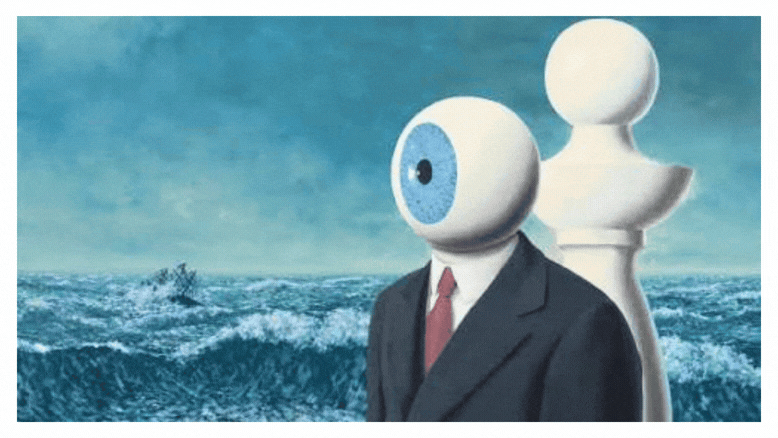
Critical thinking is often described as a logical or analytical skill, but rarely as a creative one. Yet every meaningful innovation, artistic movement, scientific discovery, or social reform begins with the same quiet act: someone questions an assumption that everyone else has accepted.
We tend to celebrate creativity through what we can see—a painting, a fashion collection, a book, or even a business idea. What often goes unnoticed is the thinking that comes before it. Original ideas rarely appear out of nowhere; they emerge from the willingness to challenge familiar beliefs, revisit accepted truths, and remain curious in the face of uncertainty.
Ironically, modern society is far better at measuring the outcomes of creativity than the thinking that makes those outcomes possible. We reward what can be marketed, monetised, or scaled, while the quieter process of questioning, reflecting, and reimagining often remains invisible. It’s a tension explored further in the creativity vs capital debate.
In an age of instant opinions, algorithmic feeds, and information overload, the most creative thing we can do may not be producing more content—it may be thinking more deliberately.
Critical Thinking Begins Where Certainty Ends
Many people mistake intelligence for critical thinking. They’re not the same. Intelligence may help us process information, but critical thinking asks us to evaluate it, question it, and, when necessary, change our minds.
Curiosity, not certainty, is what keeps ideas alive.
Egyptian writer and physician Nawal El Saadawi spent much of her life challenging inherited beliefs around power, gender, religion, and society. Her work wasn’t controversial because she sought conflict—it was because she questioned ideas that many institutions preferred to leave unquestioned.
In a different context, George Orwell showed how language can subtly influence thought, reminding us that accepting words without examining their meanings can gradually reshape how we understand reality.
Critical thinking isn’t about disagreeing for the sake of it. It’s about refusing to outsource your judgement.
Creativity Starts With Better Questions
Creativity is often imagined as a moment of inspiration. More often, it begins with discomfort.
“What if this isn’t the only way?”
“What if we’ve accepted this simply because it’s familiar?”
These are the kinds of questions that precede original thinking.
Fashion offers countless examples. Alexander McQueen wasn’t remembered because he followed convention. His collections challenged beauty standards, historical narratives, and cultural expectations. Whether people admired or criticised his work, they were rarely left indifferent.
The same pattern appears across literature, science, architecture, and philosophy. Creative breakthroughs are rarely born from agreement alone. They grow through curiosity, experimentation, revision, and the willingness to let go of ideas that no longer hold up.
Creativity and critical thinking have always evolved together. One generates possibilities; the other decides which ones are worth pursuing.
Why Critical Thinking Feels Uncomfortable Today
Although we celebrate innovation, many modern systems quietly reward conformity.
Schools often reward correct answers before thoughtful questions. Many workplaces encourage innovation while expecting employees to fit neatly within established structures—a tension that frequently shapes conversations around workplace culture. Social media, meanwhile, rewards confidence long before it rewards accuracy.
We often mistake popularity for truth, forgetting that people frequently adopt opinions for the same reason they adopt trends, “to belong.” The psychology behind mirroring in social trends reminds us that collective behaviour isn’t always the same as independent thinking.
The internet has made information abundant and attention scarce. Information has never been easier to access. Independent thought has never required more effort. Unfortunately, critical thinking depends on something algorithms struggle to reward: patience.
We fact-check restaurant reviews more carefully than some of the headlines we share.
And we celebrate “having an opinion” without asking whether that opinion has ever been challenged.
This says less about individuals than the environment we’ve collectively created. The faster information travels, the less time we give ourselves to examine it. It’s one reason ideas like toxic positivity can feel so persuasive—they offer emotional certainty in a world that rarely provides it.
Real growth, however, often begins by becoming comfortable with uncertainty. Emotions can influence how we interpret information just as much as logic does, which is why understanding the relationship between emotion and creativity also means recognising how emotions shape judgement itself.
Critical Thinking Makes Creativity More Human
As artificial intelligence becomes increasingly capable of generating text, images, and ideas within seconds, conversations about creativity have become impossible to ignore.
The more interesting question isn’t whether machines can create. It’s whether humans will continue to remain curious.
Technology can generate answers in seconds. Critical thinking begins by asking whether we are solving the right problem in the first place.
Generative AI can imitate style. But it cannot develop conviction.
It can recognise patterns. But it cannot replace lived experience, cultural memory, or genuine human judgement.
As discussions around AI art and the shifting language of human expression continue to evolve, the value of critical thinking becomes even clearer. The future of creativity may depend less on producing endless content and more on protecting the habits of mind that make original thought possible.
The Most Creative Minds Rarely Stop Questioning
Critical thinking is sometimes mistaken for cynicism. The two are fundamentally different.
A cynic assumes nothing can improve.
However, a critical thinker believes improvement is possible, but only after asking better questions.
Political philosopher Hannah Arendt argued that one of society’s greatest dangers wasn’t simply harmful ideas, but the absence of thoughtful reflection. Albert Camus, in his own way, suggested that learning to live with uncertainty is often more honest than embracing convenient answers.
The connection between critical thinking and creativity isn’t found in intelligence or talent. It’s found in curiosity.
Humility keeps us open to new evidence.
Curiosity encourages us to keep asking.
Reflection allows us to recognise when our own assumptions deserve revisiting.
Every generation inherits beliefs from the one before it. Some deserve preserving. Others deserve questioning.
Knowing the difference may be one of the most creative skills we ever develop.
A Question Worth Carrying
If every opinion you hold had to be rediscovered through experience rather than inherited from culture, family, education, or social media, which beliefs would you still arrive at on your own?