
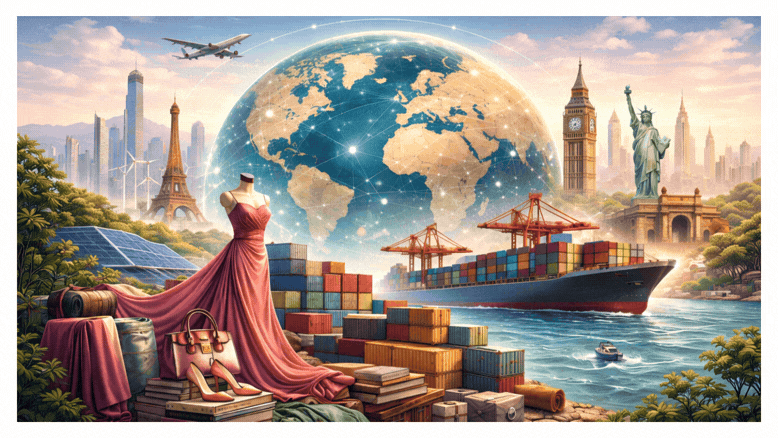
Fashion geopolitics begins long before a garment reaches a runway or a retail shelf. It begins at ports, in policy rooms, in cotton fields, in climate negotiations, and in conversations between governments that may never mention fashion directly, yet shape it entirely. What we call “trend” is often the visible tip of a far deeper political and economic current.
This blog post explores that current. Not to dramatise it, nor to accuse any one region or system, but to understand the quiet architecture behind global fashion. We will move through trade routes, labour economics, sustainability frameworks, logistics networks, and cultural power. It traces how both the East and the West participate in shaping an industry that is at once creative and strategic, emotional and infrastructural.
Global Trade & Fashion Geopolitics
The global fashion system rests on circulation—cotton from one continent, yarn from another, assembly in a third, branding in a fourth. Shipping routes like the Suez Canal and maritime corridors through the Red Sea are not abstract geography; they are structural lifelines that have, in recent years, reminded the industry how fragile global circulation can be.
When these routes are disrupted, timelines shift, costs rise, and strategies adjust. This affects both luxury houses and mass-market retailers. A delayed shipment can alter an entire season’s revenue model. A sudden policy shift can redirect sourcing patterns across continents.
Trade agreements, regional partnerships, and tariff negotiations, whether between European, Asian, African, or American economies, reshape supply chains quietly but decisively. Today, the East brings scale, manufacturing depth, and growing consumer markets. The West contributes branding ecosystems, financial capital, and regulatory frameworks. Increasingly, the balance is more reciprocal than hierarchical.
Fashion geopolitics here is less about confrontation and more about interdependence.
Labour Economics Across Borders
Labour is the human backbone of fashion geopolitics.
Mass fashion or Fast fashion often relies on large-scale production hubs in South and Southeast Asia, where evolving labour laws, wage structures, and worker protections shape global pricing. At the same time, European manufacturing regions, particularly in Italy, anchor luxury branding in artisanal craftsmanship, supported by structured labour systems and heritage skills. For instance, Luxury groups such as LVMH depend on protected European artisanal ecosystems, while global retailers like Zara operate through highly responsive international supply networks.
Neither model exists in isolation. Western fashion brands depend on Eastern production capacity; Eastern economies benefit from Western market access. Labour reforms in one region influence cost structures in another. Consumer demand for transparency pushes brands everywhere toward greater accountability.
The conversation is no longer simply luxury vs mass fashion. It is also about how value is distributed across the supply & value chain. How craftsmanship is preserved. How industrial scale is managed ethically. And how governments increasingly see labour policy as part of economic diplomacy.
Fashion geopolitics, in this context, is a negotiation between dignity, competitiveness, and global demand.
Climate Policy & the Sustainability Shift
Sustainability has moved from a marketing narrative to a policy framework.
Climate regulations in Europe, renewable energy investments in parts of Asia, and environmental mandates emerging globally are altering how textiles are produced, transported, and reported. Carbon disclosures, material traceability, and circular economy initiatives are no longer optional for brands operating internationally.
Regulatory shifts such as the European Union’s expanding sustainability reporting requirements are pushing brands to rethink transparency and carbon accountability. This transformation affects mass retailers and luxury houses alike. Fast production cycles are being questioned. Waste management systems are under scrutiny. Innovation in biomaterials, recycling, and digital technologies in fashion is becoming strategically important.
At the same time, sustainability has entered the emotion-creativity loop. Environmental awareness shapes aesthetic choices like minimalism, durability, or muted palettes, while brands translate policy compliance into storytelling. Sometimes this becomes contagious marketing; sometimes it becomes a genuine transformation. Often, it is a mixture of both.
Fashion geopolitics here reveals how environmental responsibility becomes a shared global language, interpreted differently across regions but increasingly unavoidable.
Logistics, Sanctions & Strategic Adaptation
Logistics may not appear glamorous, yet it defines modern fashion’s rhythm.
Port congestion, fuel price fluctuations, regional conflicts, and sanctions influence sourcing strategies and market access. When certain markets become politically complex, brands reassess presence—not always as a statement, but as risk management.
This affects high-end fashion labels and mass brands in similar ways. Inventory planning, diversification of suppliers, near-shoring strategies, and digital forecasting tools are becoming central to resilience. The industry is learning to decentralise to avoid overdependence on any single route or region.
Fashion geopolitics in this dimension is about adaptation rather than alarm. It is the recognition that creative industries are inseparable from geopolitical realities and that stability is a competitive advantage.
Cultural Power & Soft Influence in Fashion Geopolitics
Cultural influence is perhaps the most subtle layer of fashion geopolitics.
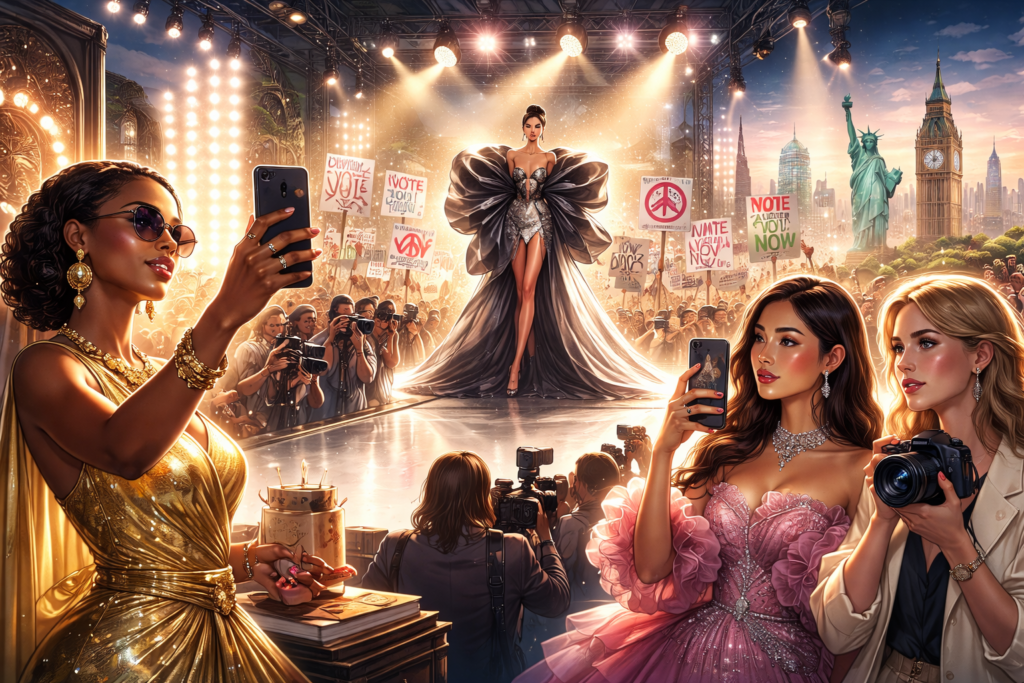
Cities such as London or Milan function as global stages where aesthetics become identity statements. Fashion weeks operate not only as commercial events but as cultural diplomacy platforms. They project values—innovation, heritage, rebellion, refinement.
Cinema also participates. The visual language of films such as The Devil Wears Prada or, more recently, Poor Things has revived discussions around exaggerated femininity, institutional power, and aesthetics that echo elements of the political art movement expression. Costume design feeds fashion imagination, which feeds retail cycles.
Fashion Influencers, whether in Seoul, Mumbai, Paris, or New York, act as distributed nodes of cultural transmission. Their role blurs marketing and diplomacy. Style travels digitally, transcending borders faster than physical goods ever could.
This is where creativity meets soft power. Taste becomes influence. And influence becomes economic leverage.
Creativity, Capital, and the Multipolar Moment
At its heart, fashion geopolitics reflects a deeper tension: creativity and capital evolving within a multipolar world.
Design is emotional. Investment is strategic. Governments are regulatory. Consumers are increasingly conscious. These forces do not cancel each other; they coexist.
The East and the West operate with different historical logics; one often rooted in scale and rapid industrialisation, the other in heritage branding and institutional capital. Yet both are recalibrating. Indian fashion, for instance, is increasingly refocusing on heritage branding, textile revival, and global runway participation, signalling that emerging markets are not merely production bases. They are cultural producers, discerning consumers, and aesthetic authorities in their own right. Western capitals are not merely arbiters of taste; they are navigating economic realignment and sustainability mandates.
The global trend is not fragmentation, but rebalancing.
Fashion geopolitics, then, is not a crisis narrative. It is a structural reality. It asks us to see garments not just as objects of desire, but as artefacts shaped by shipping corridors, labour negotiations, climate frameworks, creative movements, and strategic partnerships.
In understanding this, we do not diminish fashion’s magic. We deepen it.