
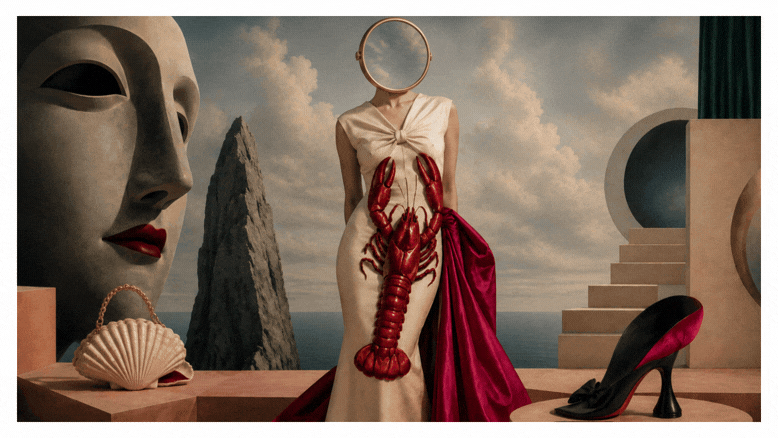
Elsa Schiaparelli didn’t invent fashion, but she may have been the first designer to convince the world that a dress could belong in a gallery as comfortably as it belonged in a wardrobe. At a time when haute couture celebrated elegance above all else, the Italian couturière introduced surrealism, symbolism, humour, wit, and artistic collaboration into clothing, transforming garments from objects of beauty into expressions of ideas, just like a canvas.
“In difficult times, fashion is always outrageous,” Elsa Schiaparelli once observed. It was more than a memorable quotation—it became the philosophy behind a career that challenged convention at every turn. Long before museums celebrated couture or luxury houses embraced interdisciplinary collaborations, she was asking a question that still resonates today: What if fashion could make people think, not just admire?
Fashion has always reflected society, but every so often, it reshapes it. Much like fashion shapes identity, clothing can communicate ambition, rebellion, humour, politics, and imagination. Schiaparelli understood this nearly a century ago, proving that couture could do far more than flatter the body—it could challenge the mind.
Who Was Elsa Schiaparelli?
Born in Rome in 1890, Elsa Schiaparelli grew up in an intellectual household surrounded by literature, archaeology, and classical art rather than sewing workshops. That unconventional upbringing would later define her approach to design. Instead of viewing fashion as decoration, she approached it as a language through which ideas could be expressed.
Her move to Paris in the 1920s placed her at the centre of one of the most creatively fertile periods in European history. Artists were abandoning realism, writers were exploring psychology, and the Surrealist movement was questioning the limits of imagination. Fashion, however, remained largely committed to refinement and impeccable craftsmanship.
Everything changed in 1927, when Elsa Schiaparelli introduced her now-famous trompe-l’œil knitwear. Featuring knitted bows and scarves that appeared deceptively real, the collection revealed a designer more interested in perception than convention. Clothing could deceive the eye, amuse the wearer, and spark conversation—all without compromising craftsmanship.
Comparisons with Gabrielle “Coco” Chanel soon became inevitable. Yet history often oversimplifies their relationship as rivalry rather than recognising two contrasting philosophies. Chanel pursued elegance through restraint, stripping fashion back to its essentials. Schiaparelli embraced surprise, believing creativity flourished when expectations were challenged. One transformed the modern wardrobe; the other transformed the way people thought about it.
Fashion Before Elsa Schiaparelli
Understanding Schiaparelli’s influence requires understanding the fashion world she inherited.
Parisian haute couture had long been synonymous with luxury, precision, and technical excellence. Success depended upon impeccable tailoring, luxurious textiles, and elaborate embroidery. Innovation certainly existed, but it usually appeared through silhouette or construction rather than concept.
Beauty remained the ultimate objective.
Schiaparelli quietly questioned that assumption.
Instead of asking how a garment could become more elegant, she asked whether elegance alone was enough. Could fashion provoke curiosity? Should humour belong in couture? Could symbolism be stitched into silk as confidently as embroidery?
Those questions reflected a broader culture shift taking place across Europe. Painters, poets, filmmakers, and philosophers were dismantling long-held assumptions about creativity itself. Fashion, until then largely confined to craftsmanship, suddenly found itself participating in the same cultural conversation.
The result was revolutionary—not because Schiaparelli rejected couture, but because she expanded its purpose.
When Fashion Became Art
The phrase “fashion as art” is often repeated today, yet few designers have embodied the idea as convincingly as Elsa Schiaparelli.
Rather than borrowing from the art world for inspiration, she welcomed artists into the creative process itself. Among her most significant collaborators was Salvador Dalí, whose fascination with dreams, symbolism, and illusion aligned perfectly with Schiaparelli’s vision. Together, they produced garments that continue to influence designers nearly a century later.
The Lobster Dress, created in 1937, remains one of fashion’s most recognisable masterpieces. An elegant ivory evening gown becomes unexpectedly surreal through Dalí’s hand-painted lobster stretching across the skirt. The design transformed an ordinary creature into an object of fascination, demonstrating that luxury could provoke thought as readily as admiration.
Equally memorable was the Shoe Hat, inspired by Dalí’s playful inversion of everyday objects. A high-heeled shoe, worn upside down on the head, challenged conventional ideas of elegance while embracing the Surrealist belief that changing context changes meaning. The piece remains humorous today, but beneath the wit lies a serious artistic question: why should familiar objects only exist where we expect them?
If those designs encouraged amusement, the Skeleton Dress of 1938 encouraged reflection. Quilted padding recreated ribs, vertebrae, and bones beneath black crepe, exposing the body’s hidden architecture without revealing any skin. Decades before conceptual designers explored themes of anatomy, mortality, and identity, Schiaparelli had already demonstrated that couture could confront subjects traditionally reserved for fine art.
The haunting Tear Dress, introduced the same year, offered another remarkable illusion. Inspired by Dalí’s paintings, the printed fabric appeared shredded despite remaining perfectly intact. Destruction became decoration, forcing viewers to reconsider whether beauty depended upon perfection or perception.
None of these garments became iconic simply because they looked unusual.
They endured because each began with an idea.
That may be Elsa Schiaparelli’s greatest contribution to fashion. She shifted attention away from garments as luxury objects and towards garments as intellectual and emotional experiences. In doing so, she laid the foundations for the art of creativity that continues to define conceptual fashion today.
The Collaborations That Changed Fashion Forever
Creative collaboration feels almost inevitable in luxury fashion today. Fashion houses partner with artists, architects, filmmakers, and musicians so frequently that the practice is often mistaken for a contemporary innovation. Elsa Schiaparelli had already embraced that philosophy nearly a century earlier.
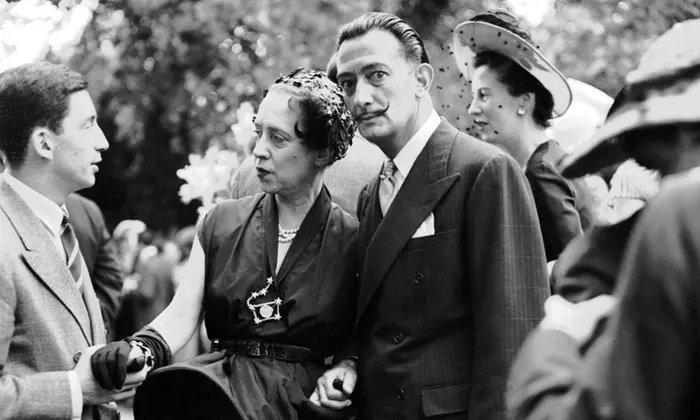
Her creative partnership with Salvador Dalí remains one of the most celebrated in fashion history, yet it was only part of a much broader artistic dialogue. Poet and filmmaker Jean Cocteau designed the now-iconic embroidered evening jacket in which two mirrored profiles formed the illusion of a vase, while sculptor Alberto Giacometti contributed jewellery and decorative elements that blurred the line between sculpture and couture.
What made these collaborations remarkable wasn’t the celebrity of the artists involved. They weren’t invited to decorate finished garments or lend cultural prestige to a collection. They became part of the creative process itself, proving that fashion could stand beside painting, literature, sculpture, and cinema as an equal creative discipline.
Luxury brands still celebrate collaboration today, but it is worth remembering where that conversation truly began. Schiaparelli wasn’t asking how art could improve fashion. She was quietly proving that fashion had always belonged within the wider world of art.
That philosophy continues to shape discussions around creativity today. Original ideas rarely emerge in isolation; they grow where disciplines overlap, challenge one another, and exchange perspectives. Fashion, like every creative field, evolves through conversation rather than imitation.
The Birth of Fashion as Storytelling
If Elsa Schiaparelli changed the relationship between fashion and art, she also transformed the way fashion communicated.
Until then, couture had largely been judged by craftsmanship, silhouette, and elegance. Schiaparelli introduced another measure: narrative.
Her collections encouraged audiences to interpret rather than simply admire. Mythology appeared alongside optical illusion. Embroidery became visual poetry. Unexpected objects found new meaning through surrealist reinterpretation. Even colour evolved into storytelling.
Perhaps no example illustrates this better than Shocking Pink. Introduced in the late 1930s, it was far more than a vibrant shade. It became an attitude—bold, playful, unapologetic, and instantly recognisable. Long before branding became a discipline of its own, Schiaparelli understood that colour could become part of a house’s identity.
That idea feels surprisingly contemporary. Today’s collections arrive with cinematic campaigns, elaborate runway productions, immersive installations, and carefully constructed narratives. Designers no longer present garments in isolation; they invite audiences into complete creative worlds.
Museums have followed the same trajectory. Couture now appears alongside paintings and sculpture in major exhibitions, not because fashion suddenly became artistic, but because institutions eventually recognised what Schiaparelli had demonstrated decades earlier.
It is also why conversations around style, sight, and self continue to resonate. Clothing shapes perception—not only how others see us, but how we understand ourselves. Schiaparelli recognised that garments could communicate imagination as powerfully as identity, a philosophy that still influences contemporary fashion.
Why Elsa Schiaparelli Disappeared
Considering her influence, the closure of the House of Schiaparelli in 1954 seems almost unimaginable.
Yet fashion has always reflected its historical moment.
The Second World War reshaped Europe socially, politically, and economically. By the late 1940s, audiences increasingly embraced stability, elegance, and optimism. Christian Dior’s celebrated “New Look” captured that mood perfectly, offering romantic silhouettes that contrasted sharply with Schiaparelli’s surreal experimentation.
Her vision hadn’t become less original. The cultural conversation had simply shifted.
Ironically, this is often the fate of genuine innovators. Their ideas become so influential that the world absorbs them while temporarily forgetting their origin. Schiaparelli’s maison closed, but the creative language she introduced quietly continued through future generations of designers.
The House of Schiaparelli Returns
For more than five decades, the House of Schiaparelli existed primarily in fashion history books, museum archives, and private collections. Although the maison officially returned to haute couture in 2012, its greatest challenge was never recreating Elsa’s designs—it was rediscovering her mindset.
Several creative directors contributed to the revival, but the house found renewed cultural relevance under Daniel Roseberry. Instead of reproducing archival garments, he interpreted Schiaparelli’s philosophy through contemporary couture. Sculptural jewellery, exaggerated anatomical details, celestial symbolism, and impossible silhouettes all echo the fearless imagination that defined the founder’s work without becoming nostalgic copies.
The revival demonstrates an important truth about creativity.
Original ideas rarely disappear.
They simply wait for another generation to recognise their value.
Elsa Schiaparelli’s Legacy in Modern Fashion
Tracing Schiaparelli’s influence through contemporary fashion is surprisingly easy once you know where to look.
Designers such as Thierry Mugler approached the human body almost as a sculpture, while later generations expanded fashion into performance, architecture, technology, and conceptual design. Their aesthetics differ dramatically, but they share one essential belief: clothing can express ideas as convincingly as any other artistic medium.
That philosophy now extends far beyond the runway. Editorial photography, museum exhibitions, costume design, and luxury branding all borrow from the language Schiaparelli helped establish. Even discussions surrounding fashion geopolitics reveal that garments communicate history, diplomacy, craftsmanship, migration, and cultural identity as much as seasonal trends.
Her influence also reminds us why Paris Fashion Haute Couture remains culturally significant. Beyond exceptional craftsmanship, haute couture has long served as a laboratory for ideas—testing new materials, challenging conventions, and expanding fashion’s creative possibilities. Schiaparelli understood that couture’s greatest value was never exclusivity alone, but its freedom to experiment without compromise.
Nearly a century later, the industry continues to celebrate innovation. Much of that conversation still echoes questions first posed by the Italian designer who arrived in Paris determined to imagine fashion differently.
Why Elsa Schiaparelli Still Matters
Fashion did not become art because museums eventually welcomed couture, nor because celebrities now wear sculptural gowns on red carpets.
It became art the moment Elsa Schiaparelli proved that an idea could be worn.
Her legacy extends far beyond the Lobster Dress, the Skeleton Dress, or surrealist collaborations with Dalí. Those creations endure because they challenged assumptions rather than simply satisfying them. They demonstrated that craftsmanship and imagination need not compete—that beauty could coexist with humour, illusion, psychology, and cultural commentary.
The history of fashion is often told through changing silhouettes, seasonal trends, or influential designers. Schiaparelli reminds us that its most significant revolutions begin somewhere less visible: with a single idea bold enough to change how we see the world.
Perhaps that is why her work continues to feel remarkably contemporary. Every time fashion chooses curiosity over convention, storytelling over decoration, or creativity over predictability, it continues a conversation Elsa Schiaparelli began almost a century ago.
Fashion didn’t become art because it entered museums.
It became art the moment Elsa Schiaparelli proved that ideas could be stitched into fabric, and the world has been wearing them ever since.
The blend of surrealism in Schiaparelli’s designs really changed the way we perceive fashion as an art form. It’s fascinating to think how her approach brought together the realms of high fashion and art galleries. I never considered how a garment could have such a profound cultural impact!
Schiaparelli’s ability to blend surrealism with fashion is truly fascinating. The idea that a dress could be considered art raises interesting questions about the boundaries between these two worlds. It’s inspiring to see how her vision transformed not just personal style but the whole concept of couture.